

A private sale usually nets a higher price, but a trade-in is same-day, has zero listing or admin, and skips the stranger-vetting a private sale puts entirely on you. Which one wins depends on whether the extra rand amount is worth two to eight weeks of your time and the risk that comes with it — and yes, you can still trade in a car you're currently financing.
Last updated 16 August 2026
- Typical price
- Private sale usually higher; trade-in usually lower — the dealer's margin covers resale risk.
- Time to sell
- Private: 2–8 weeks. Trade-in: same day.
- Admin
- Private: photos, listing, messages, viewings, verifying payment. Trade-in: none.
- Still financed?
- Trade-in still works — settlement is handled as part of the deal.
- Best for speed & certainty
- Trade-in or a direct sale.
- Best for maximum price
- Private sale, if you have the time and tolerance for admin.
"You'll always get more selling privately" is the advice everyone repeats — and it's usually true on paper. What that advice leaves out is everything a private sale actually costs you that never shows up on the price tag: your time, your risk, and the weeks the car sits depreciating while you wait for the right buyer.
What does a private sale really cost you?
A private sale can net a higher headline price, but factor in: listing fees on AutoTrader or Cars.co.za, the hours spent answering messages from people who never show up, the risk of a buyer who wants to pay in unverifiable ways, and — if you haven't sold within a few weeks — ongoing depreciation and the cost of still running two vehicles if you've already bought your next car.
None of that shows up in the sale price. All of it comes out of your pocket or your time.
What does a trade-in or direct sale actually offer?
A dealer offer is typically lower than the best-case private sale price, because the dealer is taking on resale risk and needs margin to do so. In exchange, you get a same-day or next-day answer, no listing fees, no strangers coming to your house, and one simple transaction instead of a drawn-out back-and-forth.
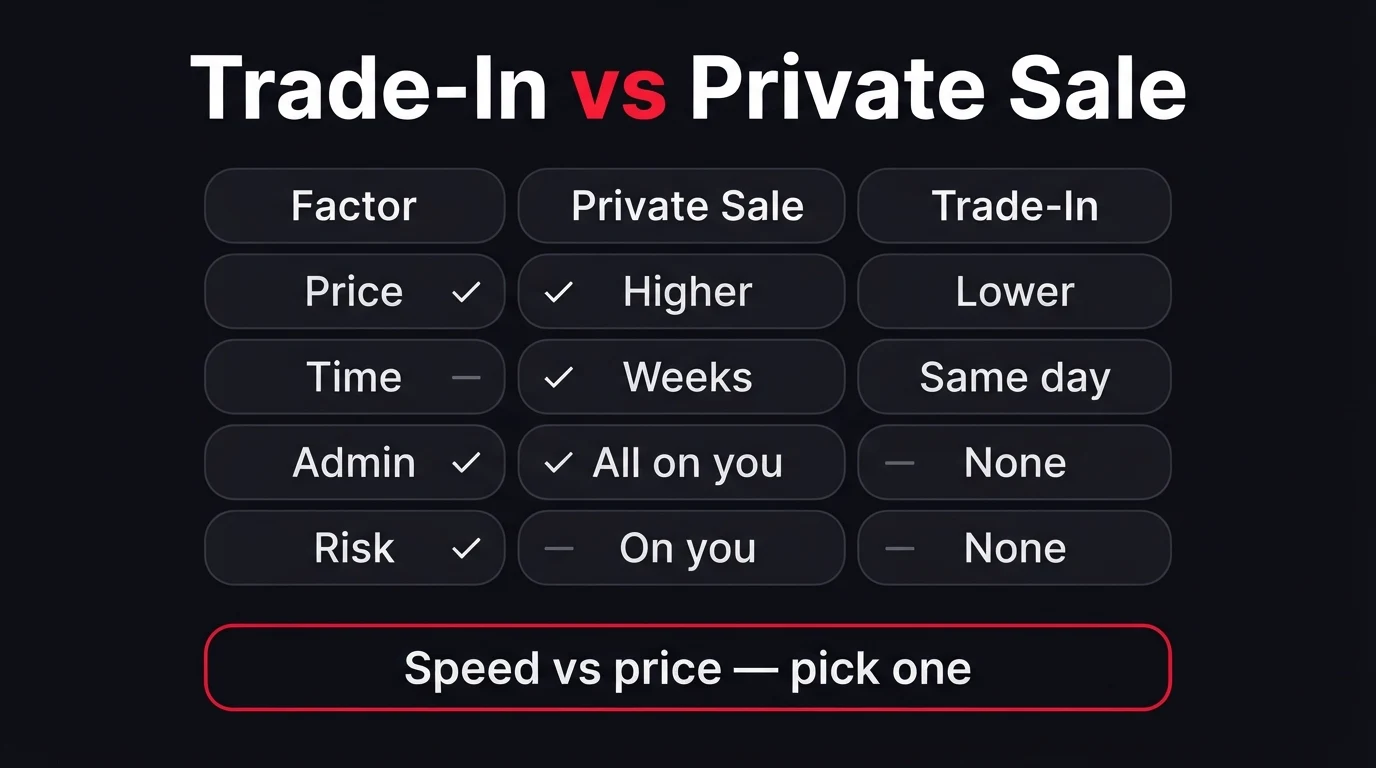
| Factor | Private sale | Trade-in / direct sale |
|---|---|---|
| Typical price | Higher | Lower — dealer margin covers resale risk |
| Time to sell | 2–8 weeks | Same day |
| Listing fees | Yes (AutoTrader/Cars.co.za) | None |
| Payment risk | On you to verify | None — the dealer pays directly |
| Handling strangers | Yes, at your home or a meeting point | No stranger contact required |
| Still financed? | Must usually settle first | Settlement built into the deal |
Figures are directional, based on typical South African private-sale and trade-in outcomes — your actual result depends on the specific car, condition and local demand.
How is a trade-in value actually calculated?
Start from book value for the make, model, year and mileage, then adjust for condition, service history, and current demand for that specific car — a popular, well-serviced model in a colour buyers actually want moves the number more than people expect. Subtract the margin and risk the dealer carries on reselling it, and that's the offer.
A full service history and honest disclosure of any damage typically move the number more than a car wash does — sellers who lead with the service book usually get a better first offer than sellers who lead with excuses.
A verbal estimate given over the phone or WhatsApp based on your description can shift once the car is actually inspected — that's normal if the car has undisclosed damage, but not if the number moves for no clear reason. Ask for the reasoning behind any change before you accept a lower figure, and get the final offer in writing.
A simple way to decide
Ask yourself three questions:
-
Do you have 2–8 weeks to wait for the right private buyer?
If your timeline is tight — you need the money now, or you've already committed to a next car — that alone often settles it.
-
Are you comfortable handling viewings with strangers and verifying payment yourself?
Private selling means vetting buyers, hosting viewings, and confirming cleared funds before you hand over keys — all on you.
-
Is the extra amount you might get privately worth more than your time and certainty?
Put a real number on your time. If the private-sale premium doesn't clear that bar, the decision is usually already made.
If you answered no to any of those, a direct sale or trade-in is very likely the better move for your situation — even though it may not be the theoretical maximum price.
Still paying off your car? You can still trade in
A common misconception is that you need to have fully paid off your car before trading it in. That's not the case — send through the make, model, year, mileage and your current settlement amount (your bank can provide this), and a fair trade-in offer can be structured around what you still owe.
If the trade-in value comes in under your settlement amount, that's negative equity — common, not unusual. The shortfall typically gets added onto the finance for your next car, so ask exactly how much that adds to your new instalment before you agree.
The short version
- Private sale nets more, but costs you 2–8 weeks, admin, and payment-verification risk.
- Trade-in is same-day with none of that — the trade-off is a lower number.
- Service history and honesty move a trade-in offer more than a valet does.
- Still financed? You can still trade in — settlement is built into the deal.
- Get the final offer in writing before you commit either way.
Frequently asked questions
Do I get less money for a trade-in than a private sale?
Usually yes, by a moderate margin — a dealer needs to resell the car at a profit and absorb the risk and cost of doing so. But once you factor in the weeks of your own time, listing fees, no-shows and the risk of dealing with strangers, the effective gap is often smaller than people expect.
Can I trade in a car I'm still paying off?
Yes. Send your settlement amount along with the car's make, model, year and mileage, and a fair trade-in offer can be worked out around what you still owe — the settlement gets handled as part of the deal, not as a separate step you have to solve first.
Does Tembani Sales buy cars outright, not just as trade-ins?
Yes — Tembani buys cars directly even if you're not buying another vehicle from him. Send photos and details on WhatsApp for a fast, fair offer, same day.
How is a trade-in value calculated?
Book value for the make, model, year and mileage, adjusted for condition, service history and current demand for that specific car, minus the margin and risk the dealer takes on reselling it. A full service history and honest disclosure of any damage typically move the number more than a car wash does.
What happens if my trade-in value is less than what I still owe?
That's negative equity, and it's common, not unusual. The shortfall between the trade-in value and your settlement amount typically gets added onto the finance for your next car — ask exactly how much that adds to your new instalment before you agree, so you're deciding with the full number, not just the trade-in figure.
Want a real number, not a guess?
Send your car's details on WhatsApp for a fast, honest trade-in or buy-in offer — financed or not.