

Between R500 and R1 500 at a private testing station in 2026, depending on the vehicle. A hatch or sedan is about R500 to R850, an SUV or bakkie R600 to R1 000, a bus or truck R800 to R1 500. There is no fixed national price, so phone ahead. The certificate is valid for 60 days.
Last updated 8 September 2026
- Cost — car (hatch / sedan)
- About R500 to R850 at a private testing station, per AutoTrader's November 2025 pricing.
- Cost — SUV or bakkie
- About R600 to R1 000.
- Cost — bus or heavy vehicle
- About R800 to R1 500, more for the largest trucks.
- Re-test after a fail
- Billed separately. Some stations re-check a minor item free within a few days; others charge a partial fee. Confirm before booking.
- How long it is valid
- 60 days from the date of issue.
- When a private car legally needs one
- Only at change of ownership (also for re-registration, imports, an engine or colour change, or moving the licence between provinces).
- Where to get it
- Any registered private or government vehicle testing station. The inspection takes about 20 to 30 minutes and the certificate is issued the same day.
This question comes up a lot on the floor, usually from someone about to sell a car or transfer one they have just bought. The honest answer has three parts: a price range, not a single number; a short list of what the test actually checks; and the handful of faults that fail most cars — nearly all of which you can sort for less than a second test costs.
How much does a roadworthy certificate cost in South Africa in 2026?
Budget R500 to R1 500. For a normal passenger car at a private testing station the figure is usually R500 to R850; SUVs and bakkies run R600 to R1 000; buses and trucks start around R800 and climb past R1 500 for the biggest vehicles. Those bands are from AutoTrader's roadworthy guide, updated November 2025.
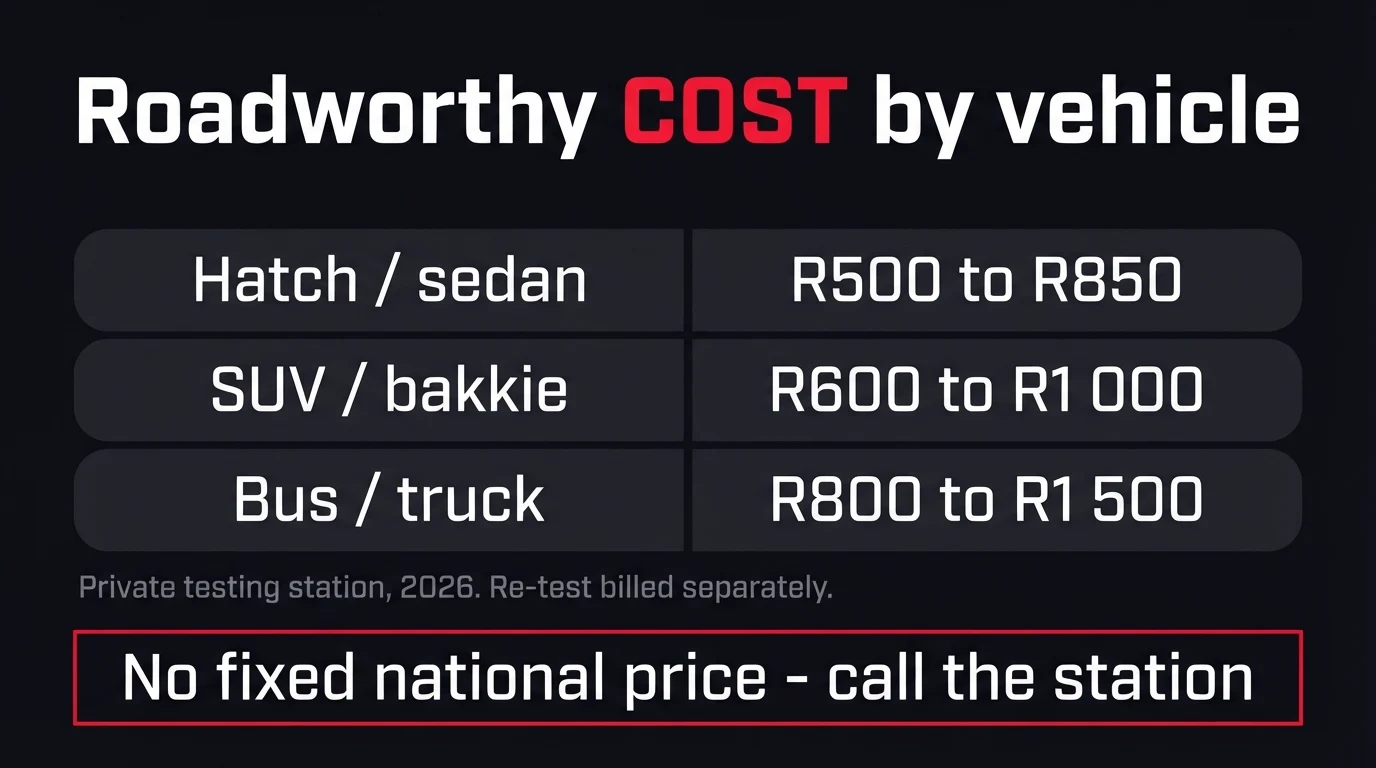
| Vehicle | Typical private-station fee (2026) |
|---|---|
| Hatch / sedan | R500 – R850 |
| SUV / bakkie / double cab | R600 – R1 000 |
| Minibus / taxi | R600 – R1 000 |
| Bus / truck | R800 – R1 500+ |
| Re-test after repairs | Free to a partial fee — station-dependent |
Government testing stations are generally cheaper than private ones; the trade-off is longer waiting times and shorter hours. A private station costs more but usually tests the same day. The certificate is worth exactly the same either way.
Why isn’t there one fixed roadworthy price?
Because the law sets the standard, not the fee. The National Road Traffic Act and its regulations define what a vehicle has to pass; each registered testing station then prices the inspection itself.
It is not an oversight — it is official. The national government service page tells owners to bring “the prescribed fee” and the Western Cape Government says plainly: “Contact the Vehicle Testing Station that you wish to visit for the price.” Price varies with vehicle type and size, the vehicle’s age, and the station. So two or three phone calls before you book is not being fussy — it is the only way to know the number.
What do they actually check?
Twelve areas, all safety-related. Nothing about performance, comfort or looks — a roadworthy is a floor, not a grade. Here is the full scope, drawn from the Western Cape Government’s published list.
| Checked | What that means in practice |
|---|---|
| Brakes | Balance across each axle, pad and disc wear, no fluid leaks, working handbrake. |
| Tyres & wheels | Legal tread, no cuts, bulges or mismatched sizes; wheels true and properly fastened. |
| Steering & suspension | No excess play, no worn ball joints or bushes, no leaking shocks. |
| Lights & electrics | All lamps work and are aimed correctly; indicators, brake and reverse lights, hooter. |
| Body & structure | No sharp edges, doors and latches work, seats and seatbelts secure, windscreen clear in the driver’s view. |
| Engine & exhaust | Secure mountings, no dangerous leaks, exhaust sound and emissions within limits. |
| Identification & papers | VIN and engine number match the registration certificate; number plates correct. |
| Instruments & dimensions | Speedometer works; the vehicle is within legal size and no illegal modifications. |
What fails cars most often — and what does each cost to fix?
Four things account for most fails: tyres, brakes, lights and the windscreen. The good news is that three of those four are cheap to put right, and you can spot them yourself in ten minutes with a torch.
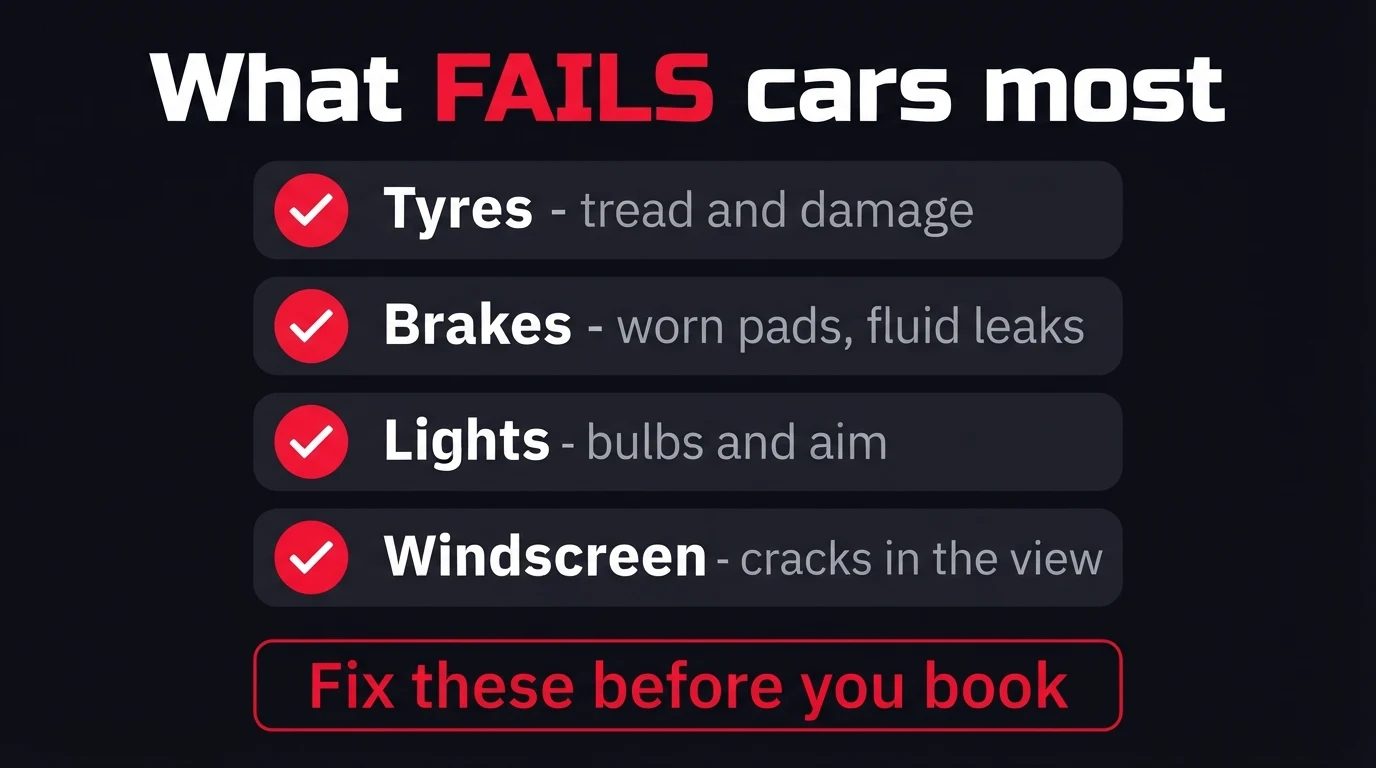
| Common fail | Rough fix cost (2026 guide, get a quote) |
|---|---|
| Wiper blades perished | R150 – R400 a pair, fitted at a spares shop |
| Blown or dim bulbs, bad aim | R40 – R200 a globe; headlight alignment often done at the station |
| Tyres below legal tread or damaged | R900 – R2 000 each fitted, by size and brand |
| Front brake pads worn | R900 – R2 500 fitted for a common hatch or SUV |
| Windscreen chip or crack in view | Chip repair R300 – R700; full replacement R1 800 – R6 000+ |
Those repair figures are a rough retail guide for 2026, not a quote — they move with your car, your tyre size and the fitment centre. Always get the work quoted in writing before you agree to it.
The South African legal minimum is 1 mm of tread across the centre three-quarters of the tyre, all the way round. Plenty of testers fail a tyre well before that if it is worn unevenly, cracked with age, or the wrong size for the car. If a tyre is close, replace it before the test — a fail plus a re-test costs you more than the tyre saved.
How long is a roadworthy certificate valid for?
60 days from the date it is issued. That window matters most when you are buying or selling: to register a change of ownership, the licensing authority needs a certificate that is under 60 days old. Let it lapse and you pay for a fresh test.
In practice, don’t get the roadworthy done weeks before the deal is ready. Line up the paperwork you need to sell the car first, agree the sale, then book the test so the certificate is fresh when the buyer goes to register.
When do you actually need a roadworthy in South Africa?
Less often than most people think. For a private vehicle under 3 500 kg, the law requires a certificate of roadworthiness only at change of ownership — not annually, not to renew your licence disc. Vehicles that carry people or goods for reward are a different story.
| Situation | Roadworthy needed? |
|---|---|
| Selling or buying a private car (change of ownership) | Yes — a valid certificate to register it in the new name |
| Renewing your annual licence disc on a private car | No |
| Re-registering a car that was deregistered | Yes |
| Registering an imported or newly built-up vehicle | Yes |
| Changing the engine, or the colour on the papers | Yes |
| Moving the licence to another province | Usually — confirm with that province |
| Taxi, e-hailing or other vehicle used for reward (under 3 500 kg) | Yes — every 12 months |
| Heavy vehicle over 3 500 kg (goods) | Yes — every 12 months |
| Bus | Yes — every 6 months |
Requirements are set nationally but administered province by province, and they change. Confirm your exact case with your licensing department. Sources: the national government service page and Western Cape Government, both current as of September 2026.
One case where you never touch this yourself: buying a new car. If you drive away in something like a Chery Tiggo Cross LiT from a dealer, the roadworthy, registration and licensing are handled for you as part of the deal.
How do you get one?
It is a same-day job at any registered testing station. The steps:
- Book at a registered testing station. Phone a private or government station, ask their price for your vehicle type, and book. Prices are not fixed, so call two or three.
- Bring the documents and the fee. Take the vehicle registration certificate, your ID, and the prescribed fee. At the station you fill in the Application for Certification of Roadworthiness (ACR) form.
- Have the vehicle inspected. Allow 20 to 30 minutes. The examiner works through brakes, tyres, steering and suspension, lights and electrics, the body and structure, and the engine and exhaust.
- Pass, or fix and re-test. Pass and the certificate is issued the same day and recorded on NaTIS. Fail and you get a written list of the defects — repair them and bring the car back.
Should you fix the car yourself first, or let the station quote you?
Do the cheap, obvious things yourself; let the station find the rest. Replace perished wipers, swap dead bulbs, and check tread and tyre pressures before you go — that is under R1 000 of parts and it clears the most common fails.
For anything mechanical — brakes, steering play, a leak — it is usually cheaper to take the fail sheet to your own mechanic than to accept a repair quote on the spot at the testing station. Get it in writing, and shop it if it looks steep.
If the car needs real money spent to pass, that is worth knowing before you decide how to sell it. A free trade-in valuation tells you what the car is worth to a dealer as it stands — sometimes that beats spending R8 000 on repairs to sell it privately for a little more.
The short version
- Budget R500 to R1 500 — about R500 to R850 for a car, more for an SUV, bakkie, bus or truck.
- There is no fixed national price. The station sets it; phone two or three before you book.
- It is valid for 60 days — time the test to the deal, not weeks ahead.
- A private car only needs one at change of ownership — not to renew the licence disc.
- Fix tyres, brakes, lights and the windscreen first — a fail plus a re-test costs more than the parts.
Frequently asked questions
How much is a roadworthy certificate in South Africa in 2026?
Roughly R500 to R1 500 at a private vehicle testing station, depending on the vehicle. A hatch or sedan is about R500 to R850, an SUV or bakkie about R600 to R1 000, and a bus or truck about R800 to R1 500, based on AutoTrader's November 2025 pricing survey. Government testing stations are usually cheaper but slower to book.
Is there a fixed price for a roadworthy test in South Africa?
No. The National Road Traffic Act sets the test standard, not the fee. Both the national Department of Transport and provincial guidance tell owners to contact the testing station for its price. The cost varies with vehicle type and size, the vehicle's age, and the station itself, so phone around before you book.
How long is a roadworthy certificate valid in South Africa?
60 days from the date of issue. If you are using it to transfer or register a vehicle, the registering authority needs the certificate to be under 60 days old, so finish the transfer inside that window. If it lapses, you pay for a fresh test.
Do I need a roadworthy certificate to sell my car privately in South Africa?
For a private vehicle under 3 500 kg, a certificate of roadworthiness is required by law at change of ownership, so the buyer will need a valid one to register the car in their name. Sellers often get the roadworthy first to make the car easier to sell, but the parties can agree who pays for it.
How much does a re-test cost if my car fails the roadworthy?
It varies by station. Some re-check a small item, like a bulb or a wiper, free of charge if you return within a few days. Others charge a partial fee for the re-inspection. Repairs are always billed separately, by whoever does the work. Ask the station its re-test policy before you book the first test.
What is the most common reason cars fail a roadworthy in South Africa?
Worn brakes and tyres, faulty or badly aimed lights, and windscreen cracks in the driver's line of sight are the usual failures, along with steering or suspension play and oil or coolant leaks. Most of these you can check yourself before booking, and fixing bulbs, wipers and tread is cheaper than a second test.
Can I get a roadworthy at a government testing station instead of a private one?
Yes. A certificate from any registered testing station, government or private, is equally valid and is recorded on NaTIS. Government stations are generally cheaper but have longer waiting times and shorter hours. Private stations cost more but usually test the same day. Both must be registered and graded to issue a certificate.
Where can I get a roadworthy certificate near me in Johannesburg?
Any registered private or municipal vehicle testing station in Gauteng can issue one, and there are dozens across Johannesburg. Call two or three near you, compare the price for your vehicle type and the next available slot, and confirm their re-test policy. If you are trading the car in to us, we can point you to a station we trust.
Selling the car this roadworthy is for? Get a figure first
Send Tembani the year, model and mileage and you will get a straight trade-in valuation — plus an honest read on whether it is worth spending money to pass a roadworthy for a private sale, or simpler to trade it in as it stands.