

Not quite as well as a Toyota or VW — but the gap is narrower than people assume and closing fast. TransUnion data puts the Chery Tiggo 4 Pro, Haval Jolion and GWM P-Series all under 30% depreciation over three years, in the same range as several established brands. Which model you buy matters more than the badge.
Last updated 18 September 2026
- Chery Tiggo 4 Pro, 3-year depreciation
- About 27% retail (TransUnion, 2022 model).
- Haval Jolion, 3-year depreciation
- About 25% retail — in the same range as several Japanese-brand rivals.
- GWM P-Series, 3-year depreciation
- About 27% retail, 34% on a dealer trade-in (TransUnion).
- Chinese-brand market share
- 22% of new-vehicle sales in Q2 2026, up 72% year-on-year.
- GWM / Haval warranty
- 7 years / 200 000 km, described by GWM as “comprehensive and transferable.”
- Chery engine warranty
- 10 years / 1 000 000 km, but first owner only — it does not transfer.
- Cheapest way around the gap
- Buy a 2–3 year old unit that's already through its steepest drop.
“Are they reliable” is the question people ask out loud. “What will it be worth when I sell it” is the one behind it. It's a fair question — and unlike reliability, resale value has real, published numbers behind it. Here's what TransUnion's book values and cars.co.za's own industry data actually show, why the gap exists, and the one decision that makes most of it irrelevant.
Why do Chinese cars depreciate faster in the first place?
Mostly because the used-car market hasn't fully caught up to the new-car market yet. A shorter local track record makes used-car buyers cautious, and caution shows up in the price they'll offer, not in anything mechanically wrong with the car.
This isn't a Chinese-brand problem specifically — it's what happens to every new entrant to the South African market. Korean brands went through the same discount two decades ago and now sell close to Japanese-brand money on the used market. The pattern is familiar; only the badge has changed.
A second factor is warranty structure. Where a brand's headline warranty doesn't transfer to the next owner (more on this below), a used buyer is getting less cover than the first owner got, which a rational buyer prices into their offer.
What do the real numbers actually show?
Better than the reputation suggests. Using TransUnion's Vehicle Valuations Database — the same book-value data South African dealerships use to price trade-ins — and cars.co.za's own 2025 industry report, here's the retail depreciation over three years on the models with real, published figures:
| Model | 3-year depreciation (retail) |
|---|---|
| BAIC X55 | ~24.5% |
| Haval Jolion | ~25% |
| Chery Tiggo 7 | ~25% |
| GWM Steed 5 | ~25% |
| Chery Tiggo 4 Pro | ~27% |
| GWM P-Series | ~27% |
| Haval H6 | Just under 30% |
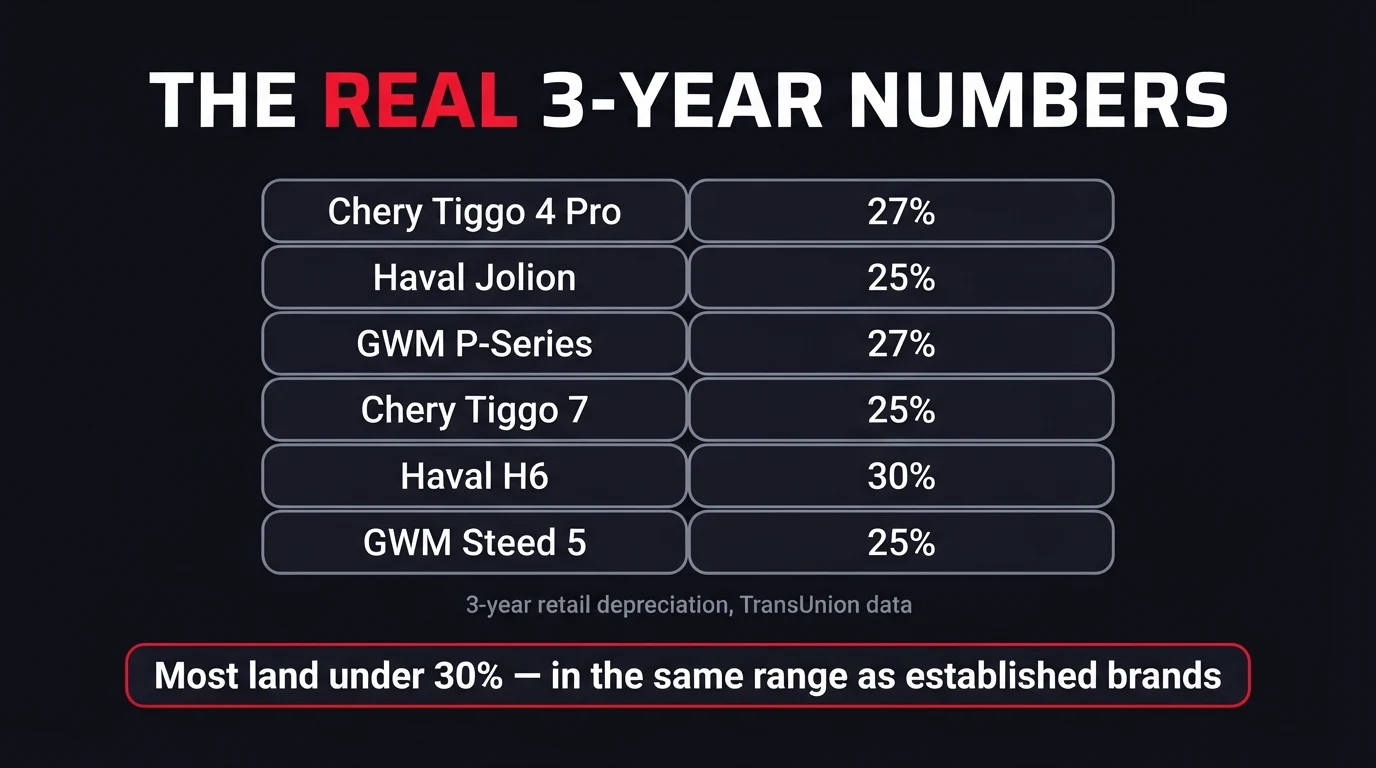
Cars.co.za's own analysis makes the comparison explicit: the Haval H6's just-under-30% figure lands in the same range as the Kia Sportage, Mazda CX-5 and Hyundai Tucson — brands nobody would call a risky resale bet. None of these Chinese-brand models are the outlier the reputation suggests.
Retail value and trade-in value are two different numbers. The figures above are what a car sells for on the open market. A dealer's trade-in offer runs roughly 7–8 percentage points lower, since the dealer carries reconditioning cost and holding risk. The Jolion and P-Series both show ~33–35% trade-in depreciation over three years against ~25–27% retail — normal for any brand, not a Chinese-car problem.
Is the gap actually closing, or is that just marketing?
It's closing, and the reason is volume, not spin. Chinese brands reached 22% of new-vehicle sales in South Africa in the second quarter of 2026, up 72% year-on-year — nearly one in every five new cars sold. Growth like that has knock-on effects a reputation alone can't produce.
The clearest sign is finance approval. Absa's Vehicle and Asset Finance data shows Chinese brands' share of SUV finance applications more than doubled since 2023, from 19% to 40%. Banks don't extend credit against a car they think nobody will want to buy back in three years — a rising finance share is a rising confidence signal, and confidence is what sets resale prices.
More new-car buyers today means a bigger, better-informed second-hand market in three years' time. That's the mechanism, not a promise — and it's already visible in how tight the gap has become on the models with real data behind them.
Does a transferable warranty change the resale maths?
Yes, and this is the detail most buyers never check. GWM describes its 7-year/200 000 km warranty as “comprehensive and transferable” — a used Haval or GWM buyer inherits real, meaningful cover, not a used car with an expired promise.
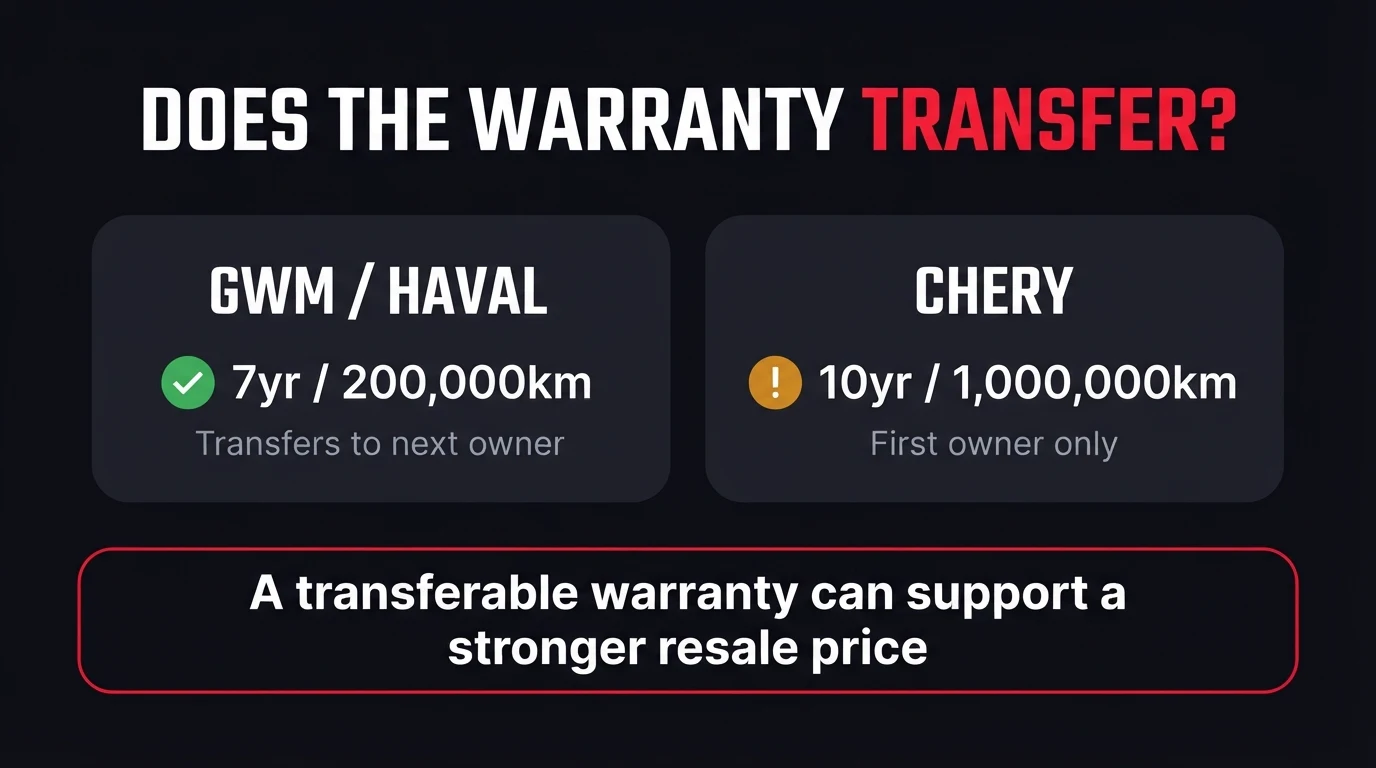
Chery's headline promise works differently. The 10-year / 1 000 000 km engine warranty is first-owner-only and does not pass to the next buyer. Sell a Chery on and the buyer is left with whatever remains of the standard 5-year/150 000 km factory warranty — the million-kilometre number that sold you the car disappears the moment you sign it over.
Warranty terms change by model year and can be updated by the manufacturer. Before you buy new or used, confirm the exact cover per VIN with the dealer — we'll walk you through the actual warranty booklet for any car on our floor rather than quote you the headline number.
The practical effect: a used GWM or Haval can defend a stronger asking price because the next owner is genuinely still covered. A used Chery has to compete on price alone once that first-owner clock runs out — which is exactly why its resale figures, while still reasonable, sit a touch above the Jolion's.
Picture this: buy-and-hold vs. trade-every-three-years — which maths applies to you?
Two buyers walk into a showroom on the same weekend and pay the identical price for the identical car. One keeps it for nine years. The other trades it in at three, then again at six. On paper they made the same decision. In the bank account, they didn't.
Here's a worked example using the Tiggo 4 Pro's real ~27% three-year figure, on an illustrative R450 000 new price — the model and price will differ for your car, but the shape of the maths won't:
| Approach | What you're exposed to |
|---|---|
| Trade every 3 years | You pay the steepest part of the depreciation curve — roughly R121 500 on this example — every single cycle, plus dealer margin and paperwork each time you swap. |
| Hold for 9 years | You pay that same steep first drop once. Depreciation curves flatten hard after year three for every brand, so years four to nine cost far less per year than the first three did — not three times the first cycle's drop. |
Illustrative example only. Assumes the ~27% three-year TransUnion figure for the Tiggo 4 Pro on a round R450 000 new price; your actual price, model and condition will change the numbers. General depreciation curves flattening after year three is standard automotive economics, not specific to this figure.
The percentage-point gap between a Chinese brand and an established one matters most to the buyer who trades every three years, because they pay the steep part of the curve repeatedly. It matters least to the buyer who holds for the long haul.
Is there a way to make the depreciation gap mostly irrelevant?
Yes — buy the car after someone else has already absorbed the steep part of the curve. A 2–3 year old car has been through its steepest depreciation already; from that point on, the curve flattens regardless of which badge is on the bonnet. You get the same car, the same warranty balance where it transfers, for meaningfully less than new.
That's the exact gap our floor is built to fill. Every used car we sell — including the Lepas L6 and the Chery Tiggo 8 Pro Max — is priced against real market data, not a guess.
You're not paying new-car money for a car that's already taken its first hit. If you're weighing a trade-in against one of these, a free trade-in valuation gives you the actual number rather than a rule of thumb.
The short version
- The resale gap is real but smaller than the reputation suggests — most popular Chinese-brand models depreciate under 30% over three years, in line with several established rivals.
- It's closing — 22% new-vehicle market share and doubled SUV finance approval since 2023 both point to a stronger used market ahead.
- Warranty transferability matters — GWM/Haval's cover passes to the next owner; Chery's headline engine warranty does not.
- Holding longer shrinks the gap's impact — depreciation is steepest in the first three years for every brand.
- Buying used sidesteps most of it — let the first owner absorb the steepest drop, then buy from there.
Frequently asked questions
Do Chinese cars hold their value in South Africa?
Not quite as well as a Toyota or Volkswagen of the same age, but the gap is smaller than most people assume. TransUnion figures put the Chery Tiggo 4 Pro, Haval Jolion and GWM P-Series all under 30% retail depreciation over three years, in the same range as several established rivals. Which specific model you buy matters more than the brand's country of origin.
Which Chinese car brand holds its value best in South Africa?
On TransUnion's three-year figures, the BAIC X55 (24.5%) and Haval Jolion (about 25%) depreciate the least among the models with published data, with the Chery Tiggo 7 close behind at around 25%. The Chery Tiggo 4 Pro and GWM P-Series sit slightly higher at around 27%. The differences between models are small next to the difference between buying new and buying already-depreciated.
Does a Chinese car's warranty transfer to the next owner?
It depends on the brand. GWM describes its 7-year/200 000 km warranty as comprehensive and transferable, so a used Haval or GWM buyer inherits real cover. Chery's 10-year/1 000 000 km engine warranty is first-owner-only and does not transfer — a used Chery buyer is left with whatever remains of the standard 5-year/150 000 km warranty. Always confirm the exact terms per VIN before you buy.
Is the resale gap between Chinese and established brands closing?
The trend points that way. Chinese brands reached 22% of new-vehicle sales in South Africa in the second quarter of 2026, up 72% year-on-year, and their share of SUV finance applications more than doubled from 19% to 40% since 2023. More volume and more finance approval means a bigger, more confident used-car market, which is exactly what supports resale prices over time.
What's the difference between a car's trade-in value and its resale value?
Resale (retail) value is roughly what the car sells for on the open market. Trade-in value is what a dealer offers you against a new purchase, and it's lower because the dealer carries reconditioning cost, holding risk and margin. TransUnion's figures show popular Chinese models at around 25-27% retail depreciation over three years but 33-35% trade-in depreciation over the same period — a normal gap, not specific to Chinese brands.
Is it cheaper to buy a used Chinese-brand car than a new one?
Usually, yes, and it's also the simplest way to sidestep the depreciation gap entirely. A 2-3 year old car has already been through its steepest drop in value, so the depreciation curve you're exposed to from that point on is much flatter — regardless of which badge is on the bonnet. You get the same car for meaningfully less, with someone else having absorbed the early value loss.
Do all Chinese car brands depreciate at the same rate?
No. Published TransUnion and cars.co.za figures show a real spread — the BAIC X55 and Haval Jolion around 25%, the Chery Tiggo 4 Pro, Chery Tiggo 7 and GWM P-Series around 25-27%, and the Haval H6 just under 30% over three years. Treat "Chinese cars" as a country of origin, not a single depreciation rate — compare the specific model, not the badge.
Should I worry about resale value if I'm keeping the car for years?
Less than a buyer who trades every three years. Depreciation is steepest in a car's first three years for every brand, Chinese or otherwise, and flattens out after that. If you hold a car for eight or nine years, you absorb that steep early drop once and then ride a much flatter curve for the rest of the ownership period — the percentage gap between brands matters far less in rand terms over a longer hold.
Want the real numbers for your specific car?
Message Tembani with the make and model you're considering, or the car you're thinking of trading in, and you'll get a straight answer on resale, warranty cover and price — not a brochure line.