

Transferring car ownership in South Africa means two separate steps: the seller submits a Notification of Change of Ownership (NCO), and the buyer submits an Application for Registration and Licensing (RLV) — both within 21 days of the sale. The change-of-ownership fee is capped at R330. Miss the 21 days and you're liable for arrears and penalties.
Last updated 17 September 2026
- Seller's form
- NCO (Notification of Change of Ownership), lodged within 21 days of the sale.
- Buyer's form
- RLV (Application for Registration and Licensing), lodged within 21 days of purchase.
- Change-of-ownership fee
- Capped at R330, gazetted May 2023.
- Deadline
- 21 days from the date of sale — for both forms.
- Miss the deadline
- Arrears and penalty charges before the vehicle can be licensed correctly.
- Roadworthy certificate
- Needed before a used car can be registered in a new name, about R500–R1 500.
- Where to submit
- Any registering authority or licensing department, in person, with original documents.
Picture this: you sold your car four months ago, shook hands, and watched it drive off. Then a red-light fine for a suburb you've never been to lands in your inbox — addressed to you.
That happens when the notification of change of ownership never reached eNaTIS, the government's national vehicle register. The car changed hands, but on paper it never did. Two forms and 21 days stand between "sold" and "no longer my problem" — here's exactly how to get both right, whether you're selling privately or driving home in something new from our floor, like a Chery Tiggo Cross LiT.
What's the full car ownership transfer process, step by step?
-
Agree the sale and check for finance owing
Get a written sale agreement or proof of purchase. If finance is still owing, get a settlement letter from the bank before anything else moves forward.
-
Get a roadworthy certificate if required
A private used-car sale needs a valid roadworthy certificate before the buyer can register the vehicle in their own name.
-
Hand over the registration certificate
The seller gives the buyer the vehicle's registration certificate, and both confirm the VIN on the papers matches the VIN on the car.
-
Seller submits the NCO
The seller completes and lodges the Notification of Change of Ownership at any registering authority, within 21 days of the sale.
-
Buyer completes the RLV form
The buyer fills in the Application for Registration and Licensing of Motor Vehicle to register the car in their own name.
-
Buyer submits the RLV with supporting documents
Lodged together with the roadworthy certificate, ID and proof of address, at a licensing department, within 21 days of the purchase.
-
Pay the transfer and licence fees
The change-of-ownership fee is capped at R330, plus the province-set vehicle licence fee.
-
Confirm the transfer went through
Check the vehicle now reflects under the new owner's name on eNaTIS before you consider the process finished.
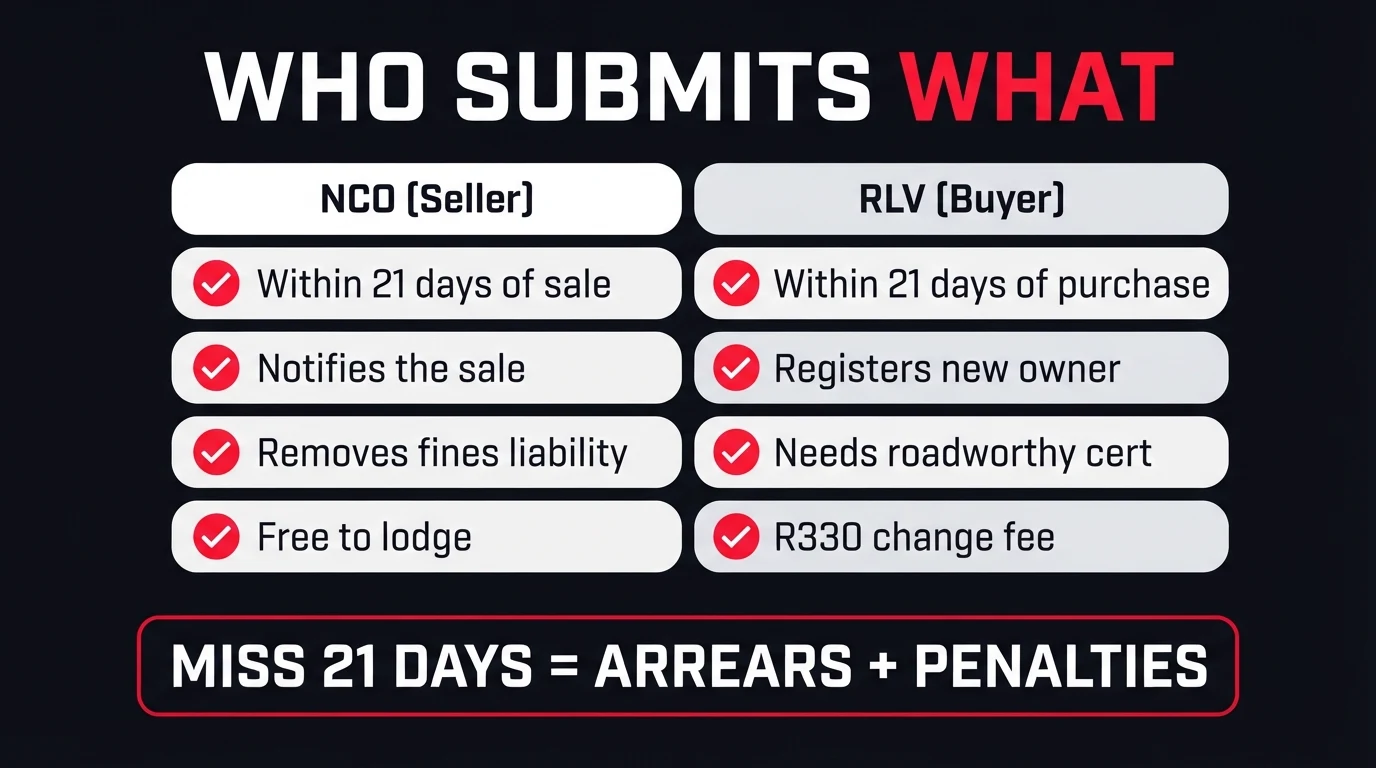
Who submits the NCO, and who submits the RLV?
The NCO and the RLV are two different forms, submitted by two different people, and mixing them up is the most common transfer mistake we see on the floor. The seller's job ends at the NCO. The buyer's job starts at the RLV. Neither one covers the other's step.
A third form, the NCP (Notification of Change of Particulars), looks similar but does something else entirely — it updates an owner's own address or personal details on a vehicle they still own. It has no role in a sale. You won't need it to transfer a car, but you will need it later if you move house.
| Form | Who submits it | What it does | Deadline |
|---|---|---|---|
| NCO | Seller | Notifies the sale, removes future liability from the seller | 21 days from sale |
| RLV | Buyer | Registers and licenses the car in the buyer's name | 21 days from purchase |
| NCP | Either owner, later | Updates an existing owner's address or details — not used for a sale | 21 days from the change |
What happens if you miss the 21-day deadline?
You become liable for arrears and penalty charges before the vehicle can be licensed correctly, and until the NCO is lodged, any fine or toll charge racked up after the sale still carries the seller's name, not the buyer's.
Handing over the keys does not end your legal connection to the car. Only a lodged NCO does. If a buyer disappears without registering it, the fines, the licence renewal, and even certain crash liabilities keep landing on you until the paper trail says otherwise. Keep a dated copy of your NCO submission as proof.
Confirm every step with your local licensing department, since enforcement and exact penalty amounts are set provincially and can change — this is the official government guidance on the process, worth a five-minute read before you go.
How much does transferring ownership actually cost?
Budget in the region of R1 300 to R3 300 total, spread across three separate fees paid by two different people. There is no single combined "transfer fee."
| Cost | Who pays | Amount |
|---|---|---|
| Change-of-ownership fee (with the NCO) | Seller | Capped at R330 |
| Vehicle licence fee (with the RLV) | Buyer | R500–R1 500, varies by province and vehicle |
| Roadworthy certificate | By agreement, usually seller | R500–R1 500 depending on vehicle type |
Those figures move by province and by vehicle, so treat them as a planning range, not a quote — confirm the exact amount with your registering authority on the day.
What documents do you need on the day?
Arrive with originals, not photos on your phone. A licensing department clerk who can't verify a document on the spot will simply turn you away.
| Document | Who brings it | Notes |
|---|---|---|
| Registration certificate | Seller hands to buyer | VIN must match the car exactly |
| Signed NCO form | Seller | Free, available at any registering authority |
| Signed RLV form | Buyer | Free, completed at the licensing department |
| Roadworthy certificate | Buyer, at registration | Valid 60 days, required for used cars |
| ID document (certified copy) | Both | Original ID for the counter, certified copy for the file |
| Proof of address | Buyer | Not older than three months |
| Proof of purchase | Both | Sale agreement, invoice, or receipt |
Do you need a roadworthy certificate to transfer ownership?
Yes — for a used car changing hands, a valid roadworthy certificate is required before the buyer can register it in their name. It's valid for 60 days, so timing it against your sale date matters.
We've broken the real cost down by vehicle type in a separate guide to roadworthy certificate costs in South Africa, including what actually gets inspected and the four faults that fail cars most often.
Can you transfer ownership if there's still finance owing on the car?
Not directly. While a bank holds finance against a vehicle, the title is encumbered, and a private transfer can't go through cleanly until that loan is settled — the bank, not the seller, still legally owns the car.
The seller needs a settlement figure from their bank first, and either pays it off before the sale or has the buyer's payment cover that settlement directly. Buying a car privately? Our guide on how to check if a used car is stolen or still has finance owing walks through verifying this from the other side, before you pay anything.
Trading a car in against something new is usually the simplest route through this exact problem — a trade-in valuation settles the outstanding finance as part of the deal, instead of you chasing a settlement letter yourself.
The short version
- Two forms, two people — the seller lodges the NCO, the buyer lodges the RLV.
- 21 days for both, counted from the date of the sale.
- Miss it and you're liable for arrears and penalty charges, and the fines still carry the old owner's name.
- Budget R1 300–R3 300 across the change fee, licence fee and roadworthy certificate.
- Finance owing must be settled before a clean transfer can happen.
Frequently asked questions
How long does it take to transfer car ownership in South Africa?
The paperwork itself is processed the same day once you're at the counter with everything complete. The real time cost is getting the NCO and RLV submitted within the 21-day window — most delays come from missing documents or an expired roadworthy certificate, not from the licensing department itself.
Can I transfer car ownership online in South Africa?
No. The NCO and RLV must currently be submitted in person at a registering authority or licensing department, with original documents. Some provinces let you book your visit online, but the actual submission still happens at the counter.
What is the difference between the NCO and NCP forms?
The NCO (Notification of Change of Ownership) is what a seller submits when a vehicle is sold. The NCP (Notification of Change of Particulars) is a different form entirely, used later by an existing owner to update their own address or personal details on a vehicle they still own — it plays no part in a sale.
Who pays for the roadworthy certificate when selling a car privately?
There's no fixed rule in law — it's whatever the buyer and seller agree in the sale. In most private sales in Gauteng, the seller pays for it since a roadworthy certificate is required before the buyer can register the car in their name at all.
What happens if the seller never submits the NCO?
The vehicle stays registered in the seller's name on eNaTIS, which means traffic fines, e-toll charges and licence renewal notices keep arriving addressed to them, even though they no longer own or drive the car. Submitting the NCO yourself, with proof of the sale, is the only way to stop that.
Do I need to transfer ownership if I sell my car to a dealer like Tembani Sales?
Yes, but a dealer trade-in removes almost all of the admin from your side — you sign the sale documents and we handle the registration process on our end, instead of you standing in a queue yourself.
How do I check that a car ownership transfer actually went through?
Ask your registering authority for a printout confirming the vehicle now reflects under the new owner's name on eNaTIS, or request this when you submit the forms. Keep it with your other paperwork — it's your proof if a dispute ever comes up later.
Can you transfer ownership of a car that still has finance owing on it?
Not directly. While a bank holds finance against a vehicle, the title is encumbered and a private transfer can't go through cleanly until the loan is settled. The seller needs a settlement figure from the bank first, or the buyer's payment needs to clear that settlement before the transfer is lodged.
Selling privately and want the admin off your plate?
A trade-in with us skips the queue at the licensing department entirely — get a free valuation and we handle the transfer paperwork from our side.