

None, legally. South African banks can approve vehicle finance with no deposit when your credit record and affordability are strong. But every R10 000 you put down cuts roughly R198 off the monthly instalment and about R4 260 off the interest on a 72-month loan at 12.5%, so 10–20% is the sensible target.
Last updated 26 September 2026
- Legal minimum deposit
- None. The National Credit Act does not set a minimum deposit; each bank decides per application.
- Sensible target
- 10–20% of the purchase price, without emptying your emergency savings.
- What R10 000 down does
- About R198 less a month and about R4 260 less interest, on 72 months at 12.5%.
- Does a trade-in count?
- Yes. Your car's value minus what you still owe on it goes in as the deposit.
- When a bank insists on one
- Usually a thin or damaged credit record, irregular income, or a big loan relative to your pay.
- Costs on top of the deposit
- An initiation fee and a monthly service fee, both shown on the bank's pre-agreement quote.
The question most people ask is "how much do I need?" The better question is "how much should I put down, and where should it come from?" This guide answers both, with the numbers worked out and every assumption on the table.
Do you legally need a deposit to buy a car in South Africa?
No. There is no legal minimum deposit for vehicle finance in South Africa. The National Credit Act requires lenders to check that you can afford the repayments — it does not tell them how much you must put down.
That's why "100% finance" and "no deposit" deals exist. If your credit record is clean and your payslip covers the instalment comfortably, a bank can finance the full price.
If it can't, the bank won't say "no deposit, no deal". It will usually ask for a deposit, offer a higher interest rate, or approve a smaller amount than you wanted. The rules sit with the National Credit Regulator (NCR), which also takes complaints about lenders.
What does a 10% or 20% deposit actually do to your instalment?
On a R350 000 car, going from no deposit to 20% down drops the instalment by about R1 387 a month and saves close to R30 000 in interest. Here is the same car, three ways.
| Same R350 000 car | 0% deposit | 10% deposit | 20% deposit |
|---|---|---|---|
| Deposit paid | R0 | R35 000 | R70 000 |
| Amount financed | R350 000 | R315 000 | R280 000 |
| Monthly instalment | R6 934 | R6 241 | R5 547 |
| Interest over 72 months | R149 242 | R134 318 | R119 393 |
| Total cost incl. deposit | R499 242 | R484 318 | R469 393 |
Worked example, not a quote. Assumes a R350 000 purchase price, 72 months, a fixed 12.5% interest rate for the full term, no balloon payment, and excludes the initiation fee, monthly service fee and insurance. Your bank sets your actual rate based on your credit profile.
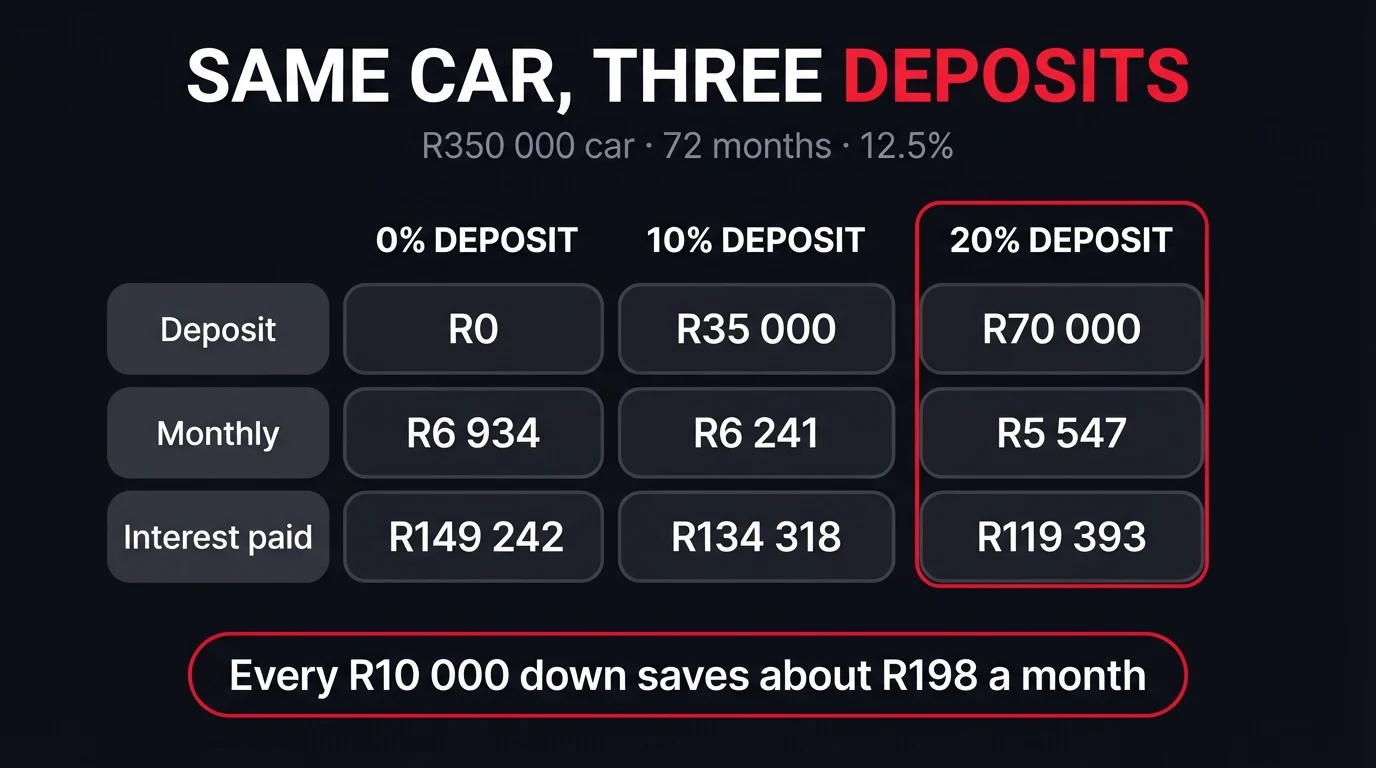
Notice the total cost only falls by about R15 000 per 10%. The deposit doesn't make the car cheap. It makes the interest bill smaller, and it makes the monthly number easier to live with for six years.
Deposit isn't the only lever, either. Here's what the loan term does to the same R315 000 (a 10% deposit) at the same 12.5%:
| Term | Monthly instalment | Total interest |
|---|---|---|
| 48 months | R8 373 | R86 890 |
| 60 months | R7 087 | R110 211 |
| 72 months | R6 241 | R134 318 |
A longer term lowers the monthly but raises the interest. A bigger deposit lowers both. That's why it's the better lever when you have the cash.
Can your trade-in be your deposit?
Picture this: you have R15 000 in savings, a 2019 hatchback in the driveway, and a new SUV in mind. You think you have a R15 000 deposit. You might have a lot more.
Yes — a trade-in works as a deposit. What counts is your equity: the dealer's offer on your car, minus whatever you still owe the bank on it.
- Car worth R120 000, R80 000 still owing → R40 000 equity, about 11% down on a R350 000 car. On the same assumptions, roughly R6 141 a month.
- Car worth R120 000, fully paid off → the full R120 000 goes in as deposit, over a third of the price.
- Car worth R120 000, R140 000 still owing → R20 000 of negative equity. That's a debt, not a deposit.
If you owe more than your car is worth, the shortfall is often rolled into the new loan. In the example above you'd finance R370 000 for a R350 000 car — about R7 330 a month, R396 more than a no-deposit deal, before you've driven off. Get a settlement letter from your bank before you shop.
Not sure what your car is worth? Get a free trade-in valuation first, so you know your real deposit before you pick a price bracket. If you're weighing a private sale, our guide to trade-in vs selling privately compares the money and the hassle.
Why is the bank's answer different from the best answer?
The bank asks one thing: can you afford the instalment? The best answer also asks what happens if something goes wrong in year two.
A car loses value fastest in its first few years, while a 72-month loan pays down slowly at the start. With no deposit, you can owe more than the car is worth for a good part of the loan.
That's fine — until you need to sell, or the car is written off.
Insurers generally pay out what the car is worth, not what you owe. A deposit is a buffer against that gap. It also puts you in a stronger position when you trade in next time, because you're more likely to have equity instead of a shortfall.
Watch for a balloon payment used to make a no-deposit deal look affordable. It lowers the monthly by leaving a lump sum owing at the end — the opposite of what a deposit does.
Should you put all your savings into the deposit?
No. Keep an emergency fund first, then put the rest down. A deposit you can't get back is no help when a tyre, a service or a slow month comes along.
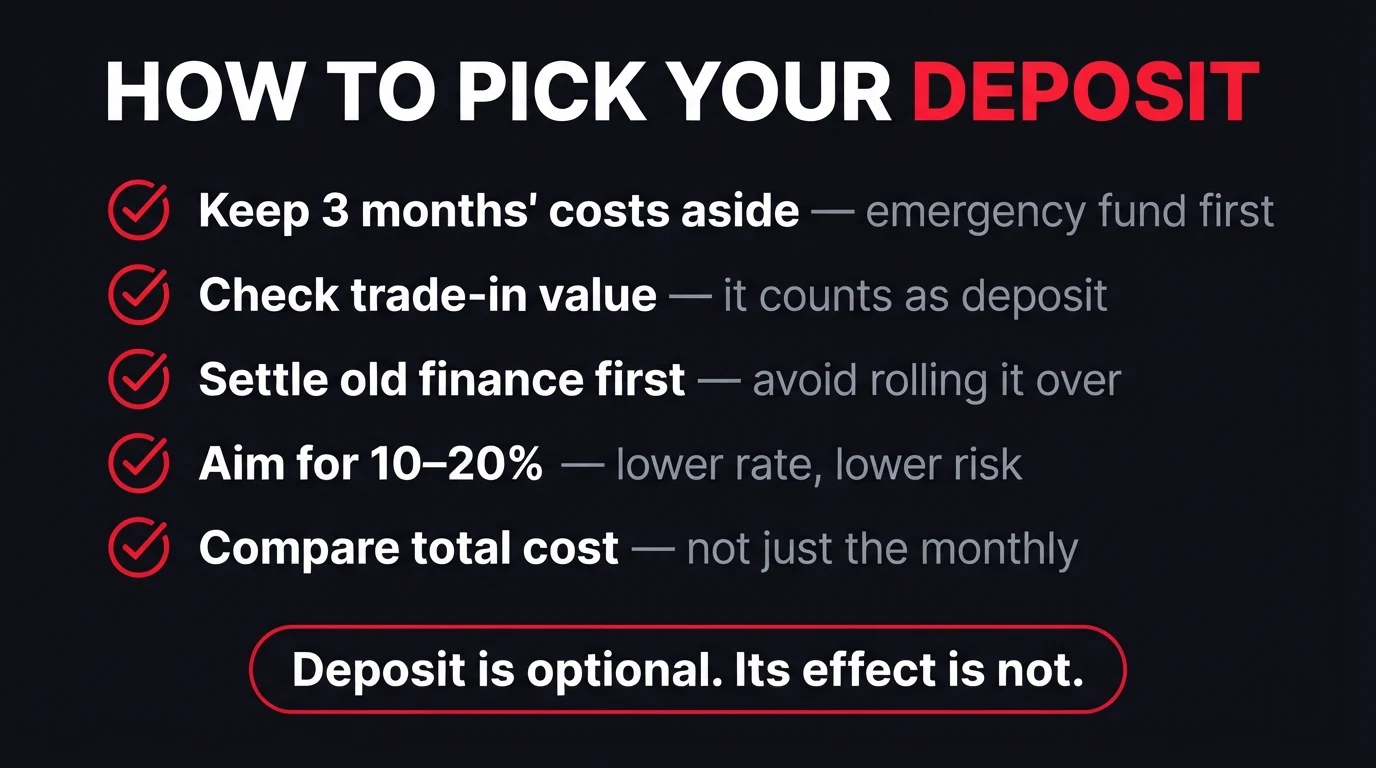
- Keep about three months of costs aside — instalment, insurance, fuel and rent — before you work out the deposit.
- Remember the up-front extras. The first insurance premium, licence and registration, and a full tank all land in the same week.
- Aim for 10–20% down if you can do it from savings or trade-in equity without touching that buffer.
- Compare total cost, not just the monthly. A low instalment bought with a long term or a balloon can cost more overall.
When will a bank insist on a deposit?
Mostly when your risk looks higher than usual. As of September 2026, the common triggers are:
- A thin credit record — first car, first loan, little history.
- Adverse listings or judgments on your credit report.
- Irregular or self-employed income that's harder to verify.
- A large loan relative to your income, or an older car with a long term.
In those cases a deposit can be the difference between approval and decline, and it may help your rate. Worried about your record? Read can you get car finance if you're blacklisted before you apply.
How do you find out what deposit you'll actually need?
Apply and let the banks tell you. The figures above are a worked example; your real number depends on your credit profile, and each bank prices it differently.
When we submit a finance application, it goes to the major South African banks, and we come back with a real number — approved amount, rate and whether a deposit is required. The lender must also give you a pre-agreement quote showing the fees before you sign.
Want to see what that looks like on an actual car? Our model pages, like the Chery Tiggo Cross LiT, show a from-per-month estimate next to each price, on a 10% deposit over 72 months at 12.5%.
The short version
- No deposit is legally required to finance a car in South Africa — banks decide per application.
- Each R10 000 down saves about R198 a month and R4 260 in interest (72 months, 12.5%).
- Target 10–20%, but keep an emergency fund before you put money down.
- Your trade-in counts — its value minus what you owe goes in as deposit.
- Negative equity gets financed, so check your settlement figure first.
- Only a bank application gives your real number — rate, amount and deposit.
Frequently asked questions
Can I buy a car with no deposit in South Africa?
Yes. There is no legal minimum deposit, and banks do approve 100% vehicle finance for applicants with a clean credit record and income that comfortably covers the instalment. You will pay a higher instalment and more interest than with a deposit, and you are more likely to owe more than the car is worth in the first years of the loan.
What is a good deposit for a car?
Between 10% and 20% of the purchase price is a sensible target for most buyers, as long as it does not wipe out your emergency savings. On a R350 000 car that is R35 000 to R70 000, which on a 72-month loan at 12.5% brings the instalment down from about R6 934 to between R6 241 and R5 547.
Does a bigger deposit get you a lower interest rate?
It can, but it is not guaranteed. Banks set your rate mainly on your credit profile and affordability. A deposit lowers the bank's risk because it lends less against the car, which can help your approval and sometimes your rate. Even at the same rate, a bigger deposit always means a lower instalment and less interest overall.
Can I use my trade-in as a deposit?
Yes. The dealer's offer on your current car, minus any finance you still owe on it, is applied to the new car's price as your deposit. If your car is worth R120 000 and you owe R80 000, you have R40 000 to put down. If you owe more than it is worth, that shortfall is added to the new loan instead.
How much does R10 000 extra deposit save on a car instalment?
About R198 a month on a 72-month loan at a 12.5% interest rate, and about R4 260 in total interest over the life of the loan. The saving is bigger at a higher interest rate and smaller over a shorter term. These figures exclude bank fees and assume a fixed rate with no balloon payment.
Is it better to pay a deposit or keep the cash?
Keep enough cash to cover about three months of living costs first, including the new instalment and insurance. Anything above that usually works harder as a deposit, because it saves you interest at your car-loan rate. Putting every rand into the deposit and then borrowing for an emergency later is the costliest option.
Want your real number, not an example?
Send us a finance application and we'll come back with what the banks will actually approve — including whether you need a deposit at all. Trading in? Get a valuation first and we'll show you what it's worth as a deposit.
Selling or trading in first? Get a free trade-in valuation.