

List on Marketplace with the eight photos buyers actually check, price against real sold listings (not asking prices), and never release the car until payment shows as cleared funds in your own banking app. Most sales stall on pricing and photos, not on finding a buyer — and most losses happen at the payment step.
Last updated 16 August 2026
- Best photo count
- 8 shots minimum — angle, interior, odometer, tyres, boot, service book.
- How to price it
- Match sold and active listings for the same make, model, year and mileage — not one asking price.
- Documents needed
- Registration certificate, roadworthy certificate (if required), your ID, settlement letter if finance is owing.
- Payment to accept
- Cleared EFT only, confirmed in your own banking app — never a screenshot.
- After the sale
- Submit the notification of change of ownership within 21 days.
- Typical time to sell
- Six to twelve weeks privately at a fair price, versus same-day at a dealer trade-in.
Marketplace is where most private car sales in South Africa now start — and where most of them stall. The listing itself is rarely the problem. It's the price, the photos and the vetting that decide whether you sell in a week or sit unsold for two months.
What are the exact steps to list a car on Facebook Marketplace?
Eight steps, in order. Do the first two before you touch the Marketplace app — pricing and paperwork decide how the rest goes.
-
Gather your documents first
Registration certificate, roadworthy certificate if required, your ID, and a settlement letter from your bank if there's finance owing. You legally cannot transfer a car the bank still holds title to.
-
Price it against real listings
Compare active and sold listings for the same make, model, year and mileage across Marketplace, AutoTrader and Cars.co.za. Set your price against that range, not a guess or what a friend paid two years ago.
-
Take the 8 photos that sell
Front three-quarter, rear three-quarter, both full sides, interior dashboard, odometer, all four tyres, the boot, and the service book — in daylight, car washed.
-
Write a listing that answers the six questions
State the mileage, service history, reason for selling, any damage, whether the price is negotiable, and what documents you have — before a buyer has to ask.
-
Vet every enquiry before a viewing
Check the buyer's profile age and history. Get their full name and get them on a phone call before you agree a time and place.
-
Meet somewhere public and controlled
A shopping centre parking area or a police station forecourt both work. Bring someone with you, and keep a copy of your licence disc, not the original, on hand.
-
Only release the car for cleared funds
Confirm the money is reflecting in your own banking app as cleared, not pending, before you hand over keys and sign anything.
-
Complete the notification of change
Submit the notification of change of ownership within 21 days so fines and licence renewals stop being your problem.
What should I price my car at on Facebook Marketplace?
Search sold and active listings for your exact make, model, year and mileage — not just one asking price you saw. Asking prices inflate; a car that's been listed for six weeks at the top of the range is telling you it's overpriced.
Cross-check across Marketplace, AutoTrader and Cars.co.za, throw out the outliers at both ends, and price at the median for a normal-speed sale, or 5–8% under it if you want to sell within two weeks. A clean logbook can justify sitting at the top of that range.
A patchy service history usually can't.
Which 8 photos actually sell a car on Marketplace?
Buyers scroll past listings with four dark, cluttered photos in under two seconds. These eight, shot in daylight on a clean car, are what get a reply instead of a scroll-past.
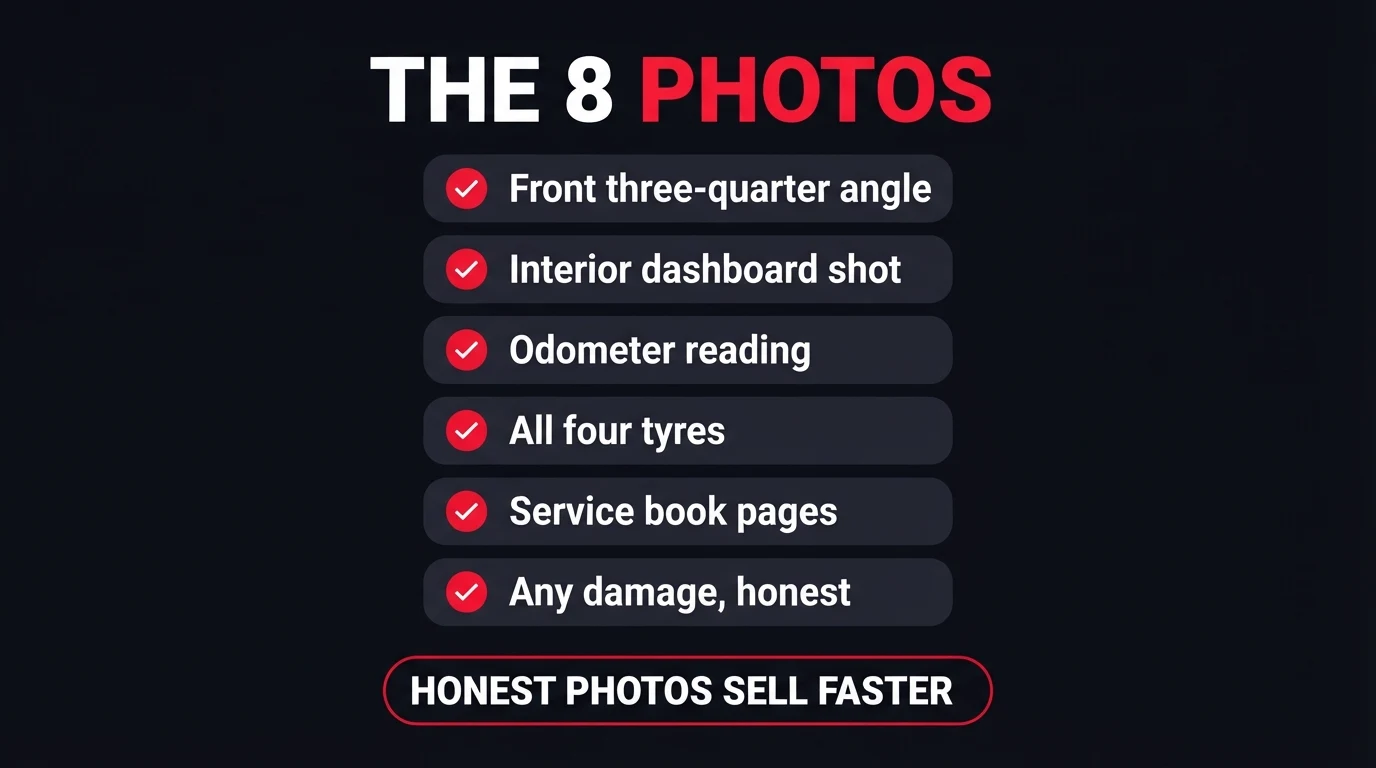
- Front three-quarter angle — the photo people click on first.
- Rear three-quarter angle — shows the boot line and rear bumper condition.
- Both full sides — panel gaps and paint match show up here, not in a close-up.
- Interior dashboard — proves the mileage claim before they even ask.
- Odometer reading, clearly lit — the single most-zoomed photo on any listing.
- All four tyres — uneven wear is the fastest trust-killer if it's hidden and found later.
- Boot space, empty — buyers picture their own life in the car here.
- Service book or invoice pages — the proof that turns "trust me" into a fact.
How do I vet a Facebook Marketplace buyer before they come to my house?
Check three things before you agree a viewing: how long their profile has existed, whether it has a real photo and real posting history, and whether they'll get on a phone call. A brand-new profile with no friends and no history is the single biggest tell of a scam account. Our rundown of common Facebook Marketplace car scams covers the rest.
Ask for their full name up front. A genuine buyer gives it without hesitation.
Someone who dodges the question, only texts, and pushes to skip straight to a deposit is telling you something before they've even seen the car.
A screenshot of an EFT confirmation can be edited in under a minute, and even a genuine one doesn't mean the funds have cleared — some transfers reverse or fail after the screenshot is sent. Instant EFT and "immediate payment" apps can also still be reversed within a short window on some banks. The only proof that matters is your own banking app showing the money as cleared, not pending. Never hand over keys before that.
Should I sell privately on Marketplace or trade in to a dealer?
A private sale usually nets more money, but it costs you time, admin, and the risk of a bad-faith buyer. A dealer trade-in is a lower number, same day, with none of that.
| Factor | Facebook Marketplace | Dealer trade-in |
|---|---|---|
| Typical price | Usually the highest number achievable | Usually below private-sale price |
| Time to sell | Six to twelve weeks at a fair price | Same day |
| Payment risk | On you to verify — fake proof-of-payment and reversed EFTs happen | None — the dealer pays directly |
| Admin | Photos, listing, messages, viewings, paperwork — all on you | Handled as part of the deal |
| Vetting strangers | Yes, at your own home or a meeting point | No stranger contact required |
Figures are directional, based on typical outcomes reported in South African private-sale and trade-in transactions — your actual result depends on the specific car, condition and local demand.
If the private-sale premium is worth the six to twelve weeks and the admin to you, sell on Marketplace. If it isn't — or the car has finance still owing, which complicates a private sale considerably — a free trade-in valuation takes minutes and gives you a real number to weigh against it.
Our full trade-in vs private sale comparison goes deeper into the maths.
The short version
- Price against sold listings, not one asking price you happened to see.
- Eight daylight photos — angle, interior, odometer, tyres, boot, service book — beat any amount of listing copy.
- Vet before you meet — profile age, real name, a phone call.
- Cleared funds only — a screenshot is not money in your account.
- File the notification of change within 21 days so fines stop being yours.
Frequently asked questions
Is it safe to sell a car on Facebook Marketplace in South Africa?
It can be, if you control three things: who comes to see the car, where you meet them, and how the money moves. Never accept a screenshot as proof of payment, never let a stranger test-drive alone, and never meet at your home if you can avoid it — a public spot with cameras, or a bank branch for the handover, is safer.
How do I price my car for Facebook Marketplace?
Search sold and active listings for the same make, model, year and mileage on Marketplace, AutoTrader and Cars.co.za, then price slightly under the median asking price for a faster sale or at the median if you can wait. Asking prices are not selling prices — cars sitting for weeks are usually overpriced, so use that as your signal too.
What documents do I need to sell my car on Facebook Marketplace?
You need the registration certificate (NATIS papers) in your name, a valid roadworthy certificate if required, your ID, and both sets of keys and the service book if you have them. If there's still finance owing, get a settlement letter from your bank before you list — you legally cannot transfer a car the bank still holds title to.
Why does "proof of payment" on WhatsApp not mean the money is in my account?
A screenshot of an EFT confirmation can be faked or edited in seconds, and even a genuine one doesn't mean the funds have cleared — some transfers reverse or fail after the screenshot is sent. Only release the car once you've logged into your own banking app and seen the money reflect as cleared funds, not pending.
Should I meet a Facebook Marketplace buyer at my house?
Rather not, especially for the first meeting. Meet at a busy public place with security cameras — a shopping centre parking area or a police station forecourt both work — and bring someone with you. Only move to a private address once you're comfortable, and never hand over keys or the car before payment has actually cleared.
How do I vet a buyer before they come to see my car?
Check how long their Facebook profile has existed and whether it has a real photo, real friends and real posting history — brand-new profiles with no history are the biggest red flag. Ask for their full name and ID number before a viewing, and be wary of anyone who won't get on a phone call and only wants to communicate by text.
What is the deposit-to-hold scam on Facebook Marketplace?
A "buyer" asks you to take the listing down and send them your banking details so they can pay a deposit to hold the car — then either the deposit never arrives, or they send a fake proof of payment and pressure you to release the car anyway. Never take a listing down or hand over the car for anything less than cleared funds in your account.
Is trading my car in to a dealer better than selling it on Facebook Marketplace?
A dealer trade-in is usually a lower number than a private sale, but it's same-day, there's no risk of a bad-faith buyer, and there's no admin — no photographing, no fielding messages, no vetting strangers. Whether that trade-off is worth it depends on how much your time and peace of mind are worth against the private-sale premium.
Want a real number before you decide?
Get a free trade-in valuation in minutes and compare it against what you'd likely net on Marketplace — no obligation either way.