

A balloon payment is a lump sum you still owe on your car when the loan ends, agreed upfront to shrink your monthly instalment. On a R350 000 car, a 20% balloon cuts the monthly by about R658 but adds R22 651 in interest, and you can owe more than the car is worth.
Last updated 29 September 2026
- What it is
- A lump sum you owe the bank at the end of the loan, set when you sign the agreement.
- Why banks offer it
- Only part of the price is repaid monthly, so the instalment looks smaller.
- What a 20% balloon does
- Cuts the instalment by about R658 a month on a R350 000 car, but adds R22 651 in interest.
- The real risk
- You owe more for longer, so the car can be worth less than your loan (negative equity).
- When it can make sense
- When you know where the lump sum will come from, or you will trade in while you still have equity.
- Legal maximum
- Each bank sets its own limit. Ask for the rand amount in the pre-agreement quote.
Picture this: two quotes for the same car. One says R6 241 a month. The other says R5 583. The second looks better, until you notice a line near the bottom that says "balloon: R70 000". That line is the whole story.
What is a balloon payment on a car?
It is a lump sum you still owe at the end of your car loan. The bank works out your instalments on only part of the price, then leaves the rest, the balloon, as one payment due on the last day.
Some people call it a residual. It is agreed and written into the contract from day one, so it is never a surprise. It just feels like one when the date arrives.
It is not a way to make the car cheaper. It moves cost to the end and, because you carry a bigger balance for longer, you pay more interest to get there.
How much does a balloon really cost you?
On a R350 000 car, a 20% balloon saves R658 a month but costs R22 651 more in interest. A 30% balloon saves R987 a month and costs R33 977 more. Here is the same car, three ways.
| Same R350 000 car | No balloon | 20% balloon | 30% balloon |
|---|---|---|---|
| Deposit paid | R35 000 | R35 000 | R35 000 |
| Amount financed | R315 000 | R315 000 | R315 000 |
| Balloon due at month 72 | R0 | R70 000 | R105 000 |
| Monthly instalment | R6 241 | R5 583 | R5 254 |
| Interest over 72 months | R134 318 | R156 969 | R168 295 |
| Total cost incl. deposit | R484 318 | R506 969 | R518 295 |
Worked example, not a quote. Assumes a R350 000 purchase price, a 10% deposit (R35 000), 72 months, a fixed 12.5% interest rate, the balloon paid in full on the last day, and no initiation fee, monthly service fee or insurance. Your bank sets your actual rate and balloon limit. As of September 2026.
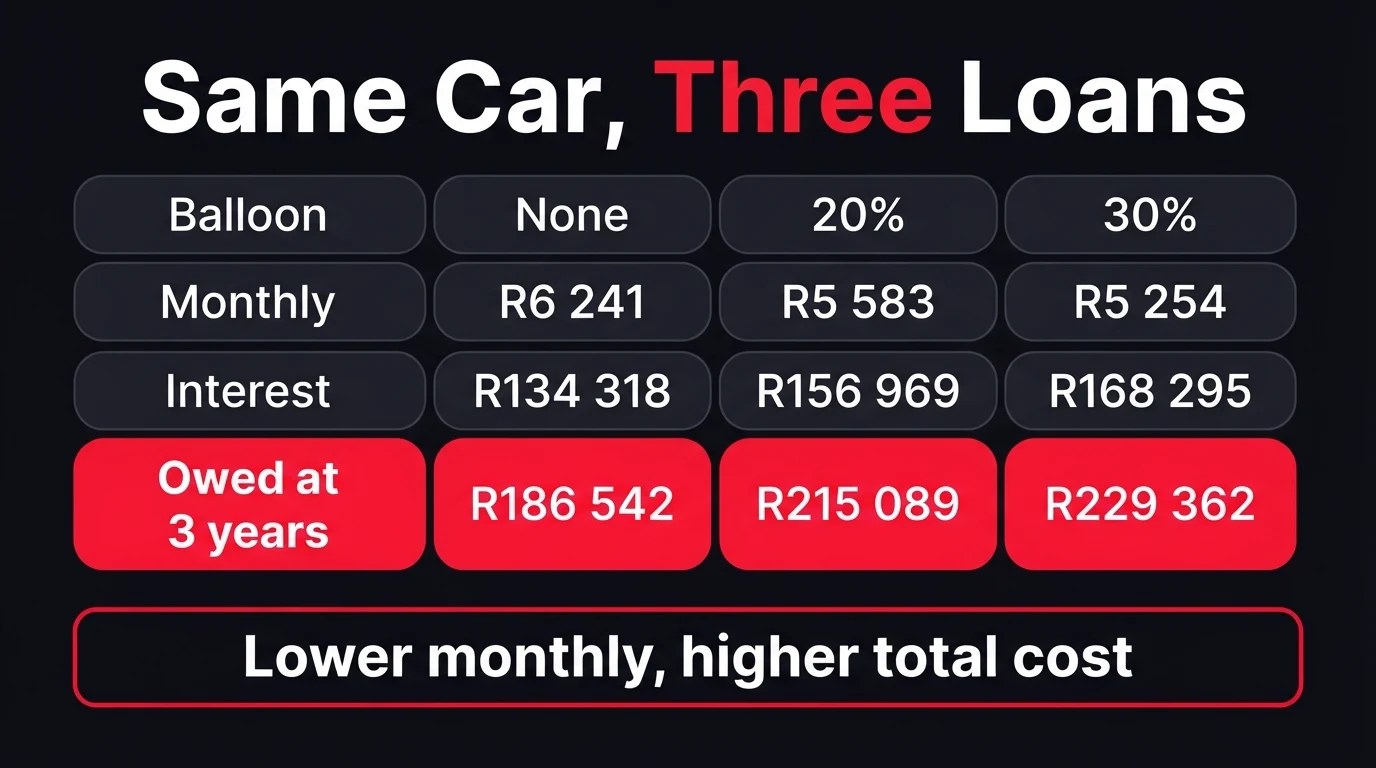
Notice what the bottom row of that graphic shows. Three years in, you still owe R186 542 with no balloon, but R229 362 with a 30% balloon. That gap is where the trouble starts.
Can a balloon payment leave you owing more than the car is worth?
Yes. That is called negative equity: your loan balance is bigger than what the car would sell for. A balloon makes it far more likely, because the balance falls slowly while the car loses value.
Say the car is worth R210 000 after three years. That figure is an assumption for this example, not a market statistic. Here is where each loan leaves you.
| After 36 months | No balloon | 20% balloon | 30% balloon |
|---|---|---|---|
| Still owed to the bank | R186 542 | R215 089 | R229 362 |
| Assumed car value | R210 000 | R210 000 | R210 000 |
| You are | R23 458 ahead | R5 089 short | R19 362 short |
Same loan assumptions as the table above. The car value is illustrative; real trade-in values depend on the model, mileage, condition and market at the time.
With a balloon, the bank is paid last, not less. If you sell or crash the car early, the insurer or buyer pays what the car is worth, not what you owe. You cover the gap out of your own pocket, or it gets rolled into your next loan.
The same trap shows up in a trade-in. If you owe more than the car is worth, a dealer cannot make that debt vanish. Our guide to trade-in vs selling privately explains how the shortfall is handled either way.
When does a balloon payment actually make sense?
Only when you have a plan for the lump sum, not a hope. If you can name where the money comes from, a balloon can be a tool. If you cannot, it is a bet.
- You expect a known lump sum before the end date, such as a policy maturing or a contracted payout, and you will set it aside.
- You plan to trade in early and you keep a close eye on whether the car is still worth more than you owe.
- You will keep the car and refinance the balloon over a short term, knowing that adds another instalment and more interest.
- A bigger deposit is not possible right now, and you have compared the total cost, not only the monthly.
It does not make sense when the only reason is that the monthly on the car you want is too high. That is a sign the car is too expensive, and a balloon just hides it for six years.
Should you save the difference instead?
You could, but it rarely covers the balloon. The 20% balloon saves R658 a month. Put every rand of it aside for 72 months and you have R47 376, against a R70 000 balloon.
That is before any interest on the savings, and before anything goes wrong in year four. To reach R70 000 by saving alone you would need to put away about R972 a month, more than the R658 the balloon saved you.
If you would rather compare on total cost, ask the bank for the pre-agreement quote. It must show the balloon, interest and fees in rands before you sign.
How do you get out of a balloon payment?
There is no way to make it disappear, but you have four real options. The earlier you start, the more of them you keep.
- Get a settlement figure. Ask your bank for a written settlement quote so you know what you owe today, not what the schedule says.
- Pay extra towards the capital. Every extra rand lowers the balance, so the balloon gets easier to cover. Check how the bank applies part-payments.
- Trade in while you have equity. If the car is worth more than you owe, the surplus becomes a deposit. Get a free trade-in valuation to find out.
- Refinance the balloon. If you keep the car, the bank may lend you the balloon as a new loan. On a R70 000 balloon over 36 months at 12.5%, that is about R2 342 a month, and it depends on you being approved.
Handing the car back does not clear the debt either. If it sells for less than you owe, you still owe the shortfall. Complaints about a lender go to the National Credit Regulator (NCR).
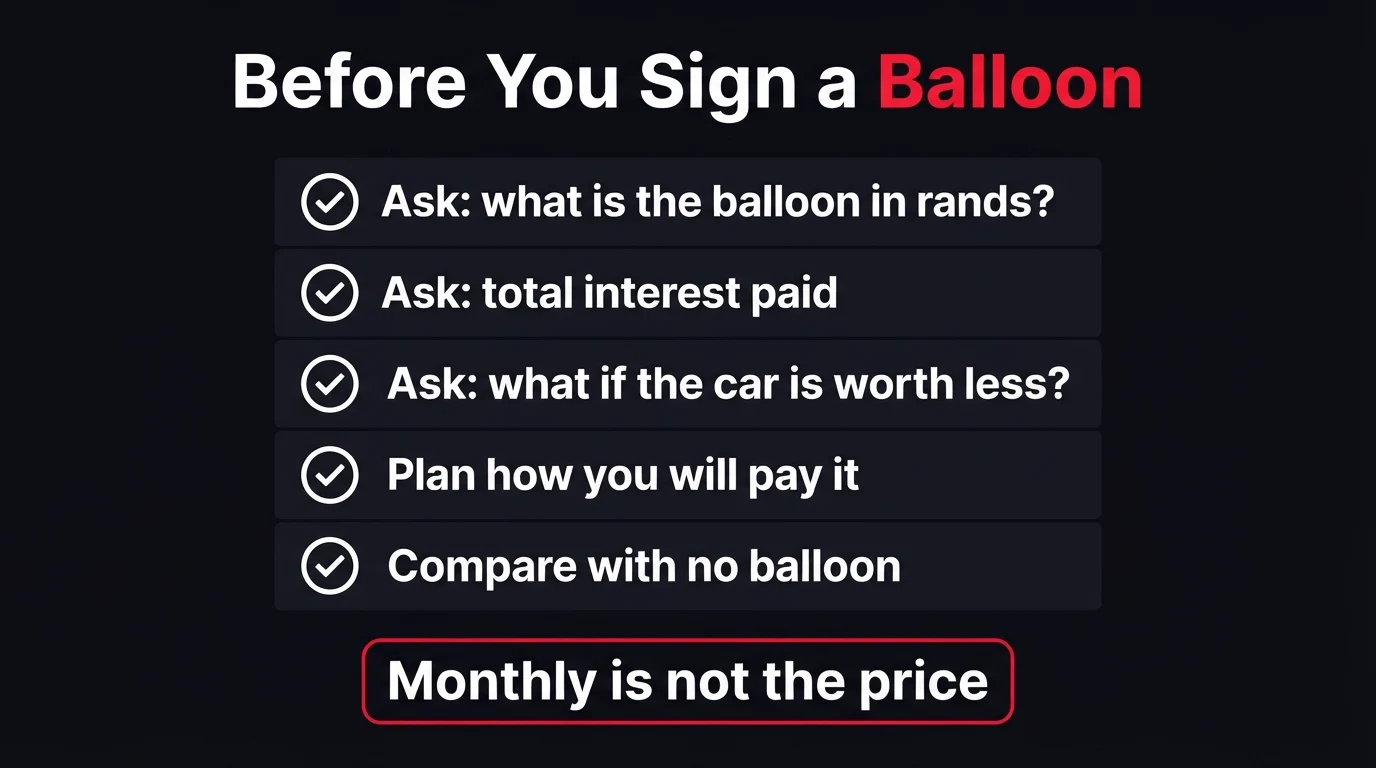
What should you ask before you sign a balloon deal?
Ask for the number, not the instalment. A salesperson can move a monthly figure by changing the term, the deposit or the balloon. The total cost is much harder to hide.
- "What is the balloon in rands, and when is it due?" The date and the amount, in writing.
- "What is the total interest and total cost?" Compare it to the same loan with no balloon.
- "What is the rate, and is it fixed?" A variable rate changes the balance you carry.
- "What if the car is worth less than the loan in year three?" If you cannot answer that comfortably, the balloon is too big.
A deposit does the opposite job. It lowers both the instalment and the interest, which is why we put it first. See how much deposit you need to buy a car for the same R350 000 example. Worried about your credit record? Read can you get car finance if you are blacklisted first.
The short version
- A balloon is a lump sum owing at the end that makes the monthly look smaller.
- A 20% balloon saves R658 a month but costs R22 651 more interest on a R350 000 car (72 months, 12.5%).
- You can owe more than the car is worth, and the gap is yours to cover.
- It makes sense only with a plan for the lump sum, or an early trade-in with equity.
- Ask for the rand balloon and total cost in the pre-agreement quote before you sign.
- If you are already in one, get a settlement figure and act early.
Frequently asked questions
What is a balloon payment on a car?
A balloon payment, sometimes called a residual, is a lump sum you still owe the bank at the end of your car loan. It is agreed when you sign, and your monthly instalments only pay off part of the price. On a R315 000 loan over 72 months at 12.5%, a R70 000 balloon lowers the instalment from R6 241 to R5 583.
Is a balloon payment a good idea?
Rarely as a default, but it can work in specific cases. It costs more in total interest and leaves you owing more, for longer. It makes sense if you know you will have the lump sum, or you plan to trade in while the car is still worth more than you owe. It is a poor fit if the only reason is a lower monthly.
What happens if I can't pay the balloon payment?
The balloon is still a debt and it falls due when the loan ends. Your options are to pay it from savings, refinance it into a new loan if the bank approves you, or sell the car and use the proceeds. If the sale price is less than the balloon, you still owe the difference. Talk to your bank before the due date, not after.
Can I settle a balloon payment early?
Yes. The National Credit Act lets you settle a credit agreement early, and your bank must give you a settlement figure on request. Paying extra towards the loan lowers the balance owed, so the balloon becomes easier to cover. Ask the bank for a written settlement quote first and check how it handles part-payments.
What is the maximum balloon payment on a car in South Africa?
Banks set their own limits, and they vary by lender, loan term, vehicle and your credit profile. Do not assume a figure. Ask each bank for the largest balloon it will approve on your loan, and ask for the pre-agreement quote showing the rand amount, total interest and total cost before you sign.
Can I trade in a car that still has a balloon payment?
Yes, provided the trade-in value covers what you owe, including the balloon. The dealer settles your loan and any surplus becomes a deposit on the next car. If you owe more than the car is worth, that shortfall is normally added to the new loan, so ask for your bank's settlement figure first.
Want the real number, with and without a balloon?
Send us a finance application and we will come back with what the banks will approve, so you can compare the instalment and the total cost side by side. Already in a balloon deal? Get a valuation and see where you stand.
Selling or trading in first? Get a free trade-in valuation. Or see the finance estimates on the Chery Tiggo Cross LiT page.