

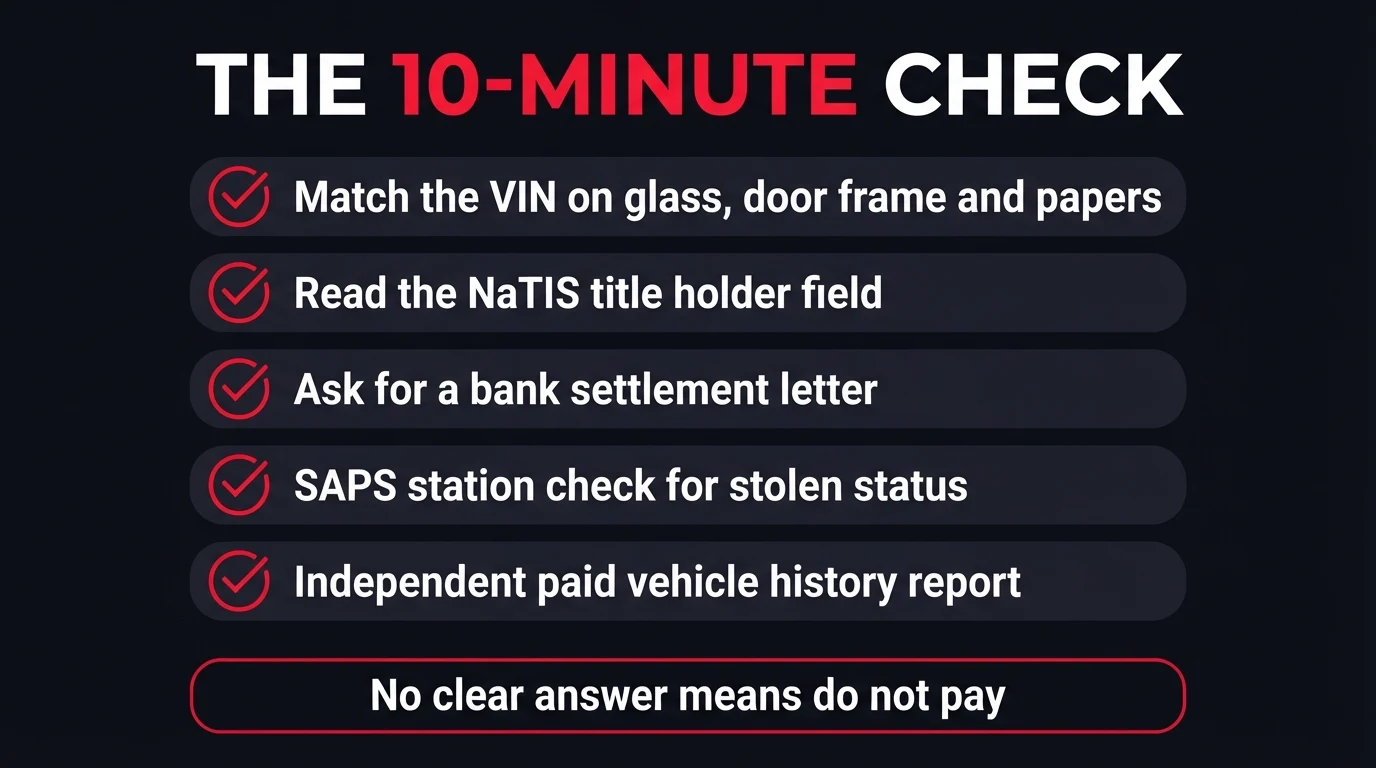
Take the car's VIN and engine number to any SAPS or Metro Police station — they will confirm, free of charge, whether it is listed as stolen and whether the numbers match the registration papers. Then check the NaTIS registration certificate: if a bank is named as title holder, finance is still owing. Do both before you pay a cent.
Last updated 30 August 2026
- SAPS stolen-vehicle check
- Free at any police station, usually done while you wait, using the VIN and engine number.
- What the SAPS check confirms
- Whether the car is flagged stolen or hijacked, and whether the VIN, chassis and engine numbers match the papers.
- Sign a car still has finance owing
- The NaTIS registration certificate names a bank or finance house as "title holder" instead of the seller.
- VIN basics
- 17 characters. The last six are the chassis number. The engine number is a separate six-digit stamp on the engine block.
- Where the VIN appears
- Windscreen base on the driver's side, the driver's door frame, the engine bay, and printed on the registration certificate and licence disc.
- Independent check
- A paid vehicle history report from TransUnion, Lightstone or a VIN service returns a stolen flag and the car's recorded details in minutes.
- The one rule
- If the seller cannot or will not produce the original papers, walk away.
A stolen car and a financed car are two different problems with the same ending: you pay, and the car is not legally yours to keep. With a stolen car the police can take it back. With a financed car the bank owns it until the loan is settled, and the person selling it to you cannot sign that away. Both are checkable in about ten minutes, and both checks have to happen before any money moves.
What is the full check, step by step?
Seven steps, in order. The first three you do standing at the car, the next three before you agree a price, and the last one before you transfer anything.
-
Note the numbers off the car itself
Write down the 17-character VIN, the chassis number and the engine number from the vehicle — not from the seller's advert or a photo they sent you.
-
Get the original NaTIS registration certificate
Ask for the original. A copy, a photo, or "it's still with the bank" all mean you cannot verify ownership yet, and that is a reason to pause, not a formality to wave through.
-
Match every number
Check the VIN at the windscreen base, on the driver's door frame and in the engine bay against the certificate and the licence disc — character for character.
-
Take the numbers to a police station
Give the VIN and engine number to any SAPS or Metro Police station and ask them to run the stolen and hijacked check. It is free and usually done on the spot.
-
Read the title holder field
On the registration certificate, find who is listed as title holder. A bank or finance house there means the car still has finance owing on it.
-
Confirm the finance is settled
If a bank is named, get a settlement letter from the seller and phone that bank yourself to confirm the balance and how settlement will be handled.
-
Run a history check, then pay on cleared funds
Pull an independent vehicle history report for anything the papers do not show, then pay only once the money has cleared as funds, not as a proof-of-payment screenshot.
How do I check if a car is stolen in South Africa?
Take the VIN and engine number to a SAPS or Metro Police station. They will check both against the national stolen and hijacked database and tell you whether the car is flagged and whether the numbers on the car match its registration documents. According to the Automobile Association of South Africa, this information is provided free of charge.
That over-the-counter check is quick but verbal. If you want it in writing — which is useful for the ownership transfer — ask about a police clearance certificate, where an officer physically inspects the VIN, chassis and engine numbers on the car. That version takes a few working days.
A tampered or re-stamped VIN is not a paperwork technicality. A number that has been ground down, re-punched, or covered with a fresh plate is the classic sign of a cloned vehicle, and it is the one thing the police counter check is built to catch.
Where is the VIN, and what must it match?
The VIN is a 17-character code. On most cars it sits at the base of the windscreen on the driver's side, on a plate or sticker in the driver's door frame, and stamped into the body in the engine bay. It is also printed on the registration certificate and the licence disc.
Every one of those has to read the same, character for character. The last six characters of the VIN are the chassis number. The engine number is a separate six-digit stamp on the engine block, and it appears on the papers too.
| Where you look | What you are checking |
|---|---|
| Windscreen base, driver's side | Full 17-character VIN, easy to read from outside |
| Driver's door frame | VIN plate or sticker — must match the windscreen |
| Engine bay | Stamped VIN and the engine number |
| Registration certificate & licence disc | Every number above, plus the registered owner and title holder |
How do I tell if a car still has finance owing on it?
Look at the title holder field on the NaTIS registration certificate. There are two names on a financed car: the owner, who drives it and is responsible for it, and the title holder, who has the legal right to it until a debt is paid. On a car with no finance, both are the seller. On a financed car, the title holder is a bank.
A bank in that field is not automatically a problem — most cars are bought on finance. It just means the loan must be settled before the seller can pass you clean title, and you need to see that happen, not take their word for it.
| On the registration certificate | What it tells you |
|---|---|
| Owner and title holder are both the seller | No finance recorded — still confirm with a paid history check |
| Title holder is a bank or finance house | Finance is owing — get a settlement letter and call the bank |
| Seller only has a copy, "original is with the bank" | Finance almost certainly still active — the bank holds the original until it is paid off |
| Seller's name is not on the certificate at all | Do not proceed until they explain and prove why |
If a bank is listed, ask the seller for a settlement letter and then phone that bank yourself. A genuine seller settling their car will let you route the payment to the bank directly, with any balance to them — that is normal and it protects both of you.
What actually happens if you buy a car with finance still on it?
Picture this: the price is R30 000 under book, the seller is friendly, and they want the deposit tonight "because someone else is coming in the morning." You pay. Three months later the bank repossesses the car, because the seller stopped paying the loan and the loan was always the bank's claim, not the seller's to sell around.
You are now out the money and the car. Chasing the seller means a civil claim against someone who has already shown you who they are.
A car priced well under market, with pressure to pay a deposit fast and see the papers "later," is the most common vehicle scam pattern in South Africa. Slow the deal down. A seller with nothing to hide will wait a day for you to do a police check and read the registration certificate. One who will not is answering the question for you.
Is a paid vehicle history check worth it?
On any private sale, yes. A history report from TransUnion, Lightstone or a VIN service cross-checks the car against records the seller's paperwork will never show you: whether it is listed as stolen, whether it is under finance, and whether it has been written off and rebuilt. It runs online in minutes off the VIN.
It does not replace the police counter check or reading the papers — it sits on top of them. Think of it as the cheap second opinion before a purchase worth tens or hundreds of thousands of rands.
- Stolen or hijacked flag — cross-referenced against SAPS records
- Finance / title status — whether a credit provider has an interest registered
- Write-off history — previously scrapped, code 2 or code 3, or rebuilt
- Identity match — make, model, year and engine against the VIN you were given
What does a dealer do differently, and is that what you are paying for?
Before a car reaches our floor, the finance is settled and the title is clear, the VIN and engine numbers are checked, and the car has a valid roadworthy. You are buying from a fixed address in Park Meadows that is still here next month if something is wrong. That is the difference a dealer price includes.
| Factor | Private seller | Dealer (Tembani Sales) |
|---|---|---|
| Stolen-status check | You take it to the police | Done before it is listed |
| Outstanding finance | You verify and route payment | Settled, title already clear |
| VIN / number matching | All on you | Checked on intake |
| Recourse if something is wrong | Civil claim against an individual | A registered business you can come back to |
None of this means never buy privately — plenty of honest private sales happen every day. It means that when you buy privately, every check in this article is your job, and the money you might save is the fee you are charging yourself to do it. If you would rather skip that, browse the showroom or read our used-car buying checklist for Johannesburg.
The short version
- SAPS or Metro Police check the VIN and engine number against the stolen database free, on the spot.
- The NaTIS "title holder" field is the finance test — a bank there means money is still owing.
- The VIN must match the glass, the door frame and the papers, character for character.
- A paid history report (TransUnion, Lightstone) fills the gaps the papers do not show.
- If the seller will not produce original papers, that is your answer — walk away.
Frequently asked questions
Is checking if a car is stolen free in South Africa?
Yes. Any SAPS or Metro Police station will check the VIN and engine number against the stolen and hijacked database at no charge, usually while you wait. A printed police clearance certificate, where an officer physically inspects the numbers on the car, takes a few working days and is the stronger document if you want it in writing for the transfer.
What is the difference between the owner and the title holder on a NaTIS document?
The owner is the person who uses the car and is responsible for it. The title holder is whoever has the legal right to it until a debt is paid, usually a bank or finance house. If the title holder is a bank, the car is still financed and the seller cannot pass you clean title until the account is settled in full.
Can I check a car's finance status online myself?
You can pull a paid vehicle history report from TransUnion, Lightstone or a VIN service that flags whether a car is under finance, listed as stolen, or previously written off. It will not give you the exact settlement balance. For that you still need the seller's bank to issue a settlement letter in writing.
Where do I find the VIN and engine number on a car?
The VIN is a 17-character code at the base of the windscreen on the driver's side, on the driver's door frame, and stamped on the body in the engine bay. The last six characters are the chassis number. The engine number is a separate stamp on the engine block. All of them must match the registration certificate exactly.
What happens if I already paid for a car that still had finance on it?
Contact the bank named as title holder immediately and get everything in writing. If the seller stops responding, open a case with SAPS. You may be able to settle the outstanding balance yourself to keep the car and then pursue the seller for that money, but it is a cost on top of what you already paid, which is why the check has to happen before payment.
How long is a SAPS police clearance certificate valid?
It reflects the car's status on the day the numbers were inspected. Most buyers obtain it at the point of sale and use it for the ownership transfer. If several weeks pass before you register the car, a police station can re-check the stolen status quickly and free of charge.
Is buying from a dealer safer than a private sale for this?
For title and stolen-status risk, yes. A dealer settles any outstanding finance before the car reaches the floor and carries the accountability of a fixed business address you can return to. A private seller can be cheaper, but every check in this article becomes your job, and a private sale gives you little recourse if something turns out to be wrong.
Want a second pair of eyes before you pay?
If you are looking at a car privately and want to be sure it is clean, message Tembani — or skip the risk and view stock that has already been checked and has clear title.