

Before you pay a deposit: check the VIN matches the papers, confirm there's no outstanding finance against the car (a settlement letter or a TransUnion/Lightstone check using the VIN), inspect for accident-repair signs and uneven tyre wear, and get an independent pre-purchase inspection if you're not mechanically confident. Outstanding finance is the single most common way private buyers in South Africa lose money.
Last updated 16 August 2026
- Most common buyer mistake
- Paying before confirming there's no outstanding finance against the car.
- Pre-purchase inspection cost
- R1 000–R2 000, via the AA, Dekra or an independent workshop.
- Dealer purchase documents
- ID, proof of address (under 3 months), driver's licence, plus finance docs if applicable.
- VIN location
- Windscreen base and door frame — must match the registration certificate exactly.
- Finance check services
- TransUnion and Lightstone, using the vehicle's VIN.
- Biggest scam pattern
- Below-market price plus pressure to pay a deposit fast.
Buying a used car goes wrong in one of three places: the car itself has a hidden problem, the paperwork isn't what it seems, or the finance falls through after you've already gotten attached to the car. Work through this checklist in order and you'll avoid the mistakes that actually cost people money.
What's the full used-car buying checklist, in order?
-
Inspect the car properly, not just a test drive
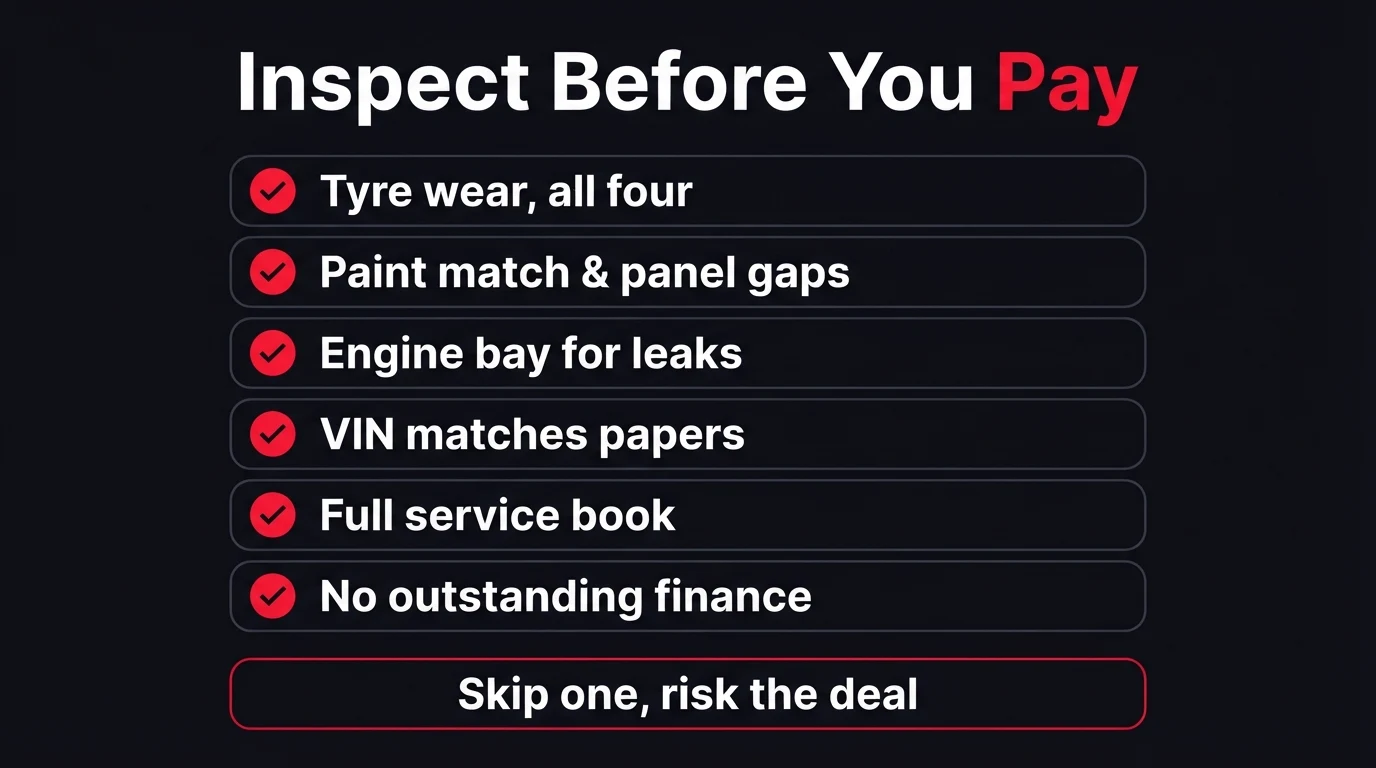
A five-minute test drive tells you very little. Check tyre wear on all four corners, look for mismatched paint or uneven panel gaps, and check the engine bay for leaks.
-
Confirm the paperwork matches the car
The VIN on the vehicle must match the registration certificate exactly. Confirm the seller's name matches the registered owner, or get a clear explanation if not.
-
Rule out outstanding finance
Ask for a settlement letter, or run a vehicle check using the VIN through TransUnion or Lightstone — before you pay anything, not after.
-
Get an independent pre-purchase inspection
Especially on a private sale. R1 000–R2 000 is a fraction of what a hidden problem could cost you later.
-
Know your instalment before you fall in love with the car
Work out your realistic monthly instalment with your actual deposit and a rate you'd qualify for — before you're standing next to the car you want.
-
Decide: dealer or private seller
A dealer stands behind the sale. A private seller can be cheaper, but you carry the full verification burden yourself.
What should I inspect on the car itself?
A five-minute test drive tells you very little. Check tyre wear on all four corners — uneven wear can point to alignment or suspension issues. Look for mismatched paint or uneven panel gaps, both signs of accident repair.
| What you see | What it might mean |
|---|---|
| Uneven tyre wear | Alignment or suspension issue |
| Mismatched paint or panel gaps | Prior accident repair |
| Fresh oil, or an unusually clean engine bay | Possible leak being hidden |
| Reluctance to show original papers | Ownership or finance complication |
Ask for the full service book, not just a verbal "it's been serviced." If you're not confident doing this yourself, a pre-purchase inspection from an independent mechanic costs a fraction of what a hidden problem could cost you later.
How do I confirm the paperwork actually matches the car?
Check that the VIN on the vehicle (usually on the windscreen base and door frame) matches the registration certificate exactly. Confirm the seller's name matches the registered owner, or get a clear explanation if not — a deceased estate or a company vehicle are both normal, a vague answer isn't.
If anything about the paperwork feels rushed, or the seller is reluctant to show originals, treat that as a real warning sign, not a minor inconvenience.
Paying in full for a car that still has an outstanding bank loan against it. The bank — not the seller — legally owns the car until it's settled, and you can end up with neither the car nor your money back. Ask for a settlement letter, or run an independent vehicle check using the VIN through TransUnion or Lightstone. A dealer selling you a car has already cleared this.
What is a pre-purchase inspection, and do I need one?
It's an independent mechanical check done before you pay — typically by the AA, Dekra or an independent workshop, usually costing R1 000 to R2 000 depending on who does it and how deep they go. You are always entitled to arrange one.
On any private sale, get one. On a dealer car, ask what checks the dealer has already done and whether you can still take it to your own mechanic — a dealer who refuses is telling you something.
Know your instalment before you fall in love with the car
It's easy to stretch your budget once you're standing next to the car you want. Work out your realistic monthly instalment first, with your actual deposit and a rate you'd realistically qualify for — our finance calculator gives you a working estimate in seconds. Banks look at your full credit profile, so treat any online estimate as a guide, not a guarantee, and get pre-approval sorted before you commit to a specific car.
Is it safer to buy from a dealer or privately?
Private sellers can sometimes be cheaper, but you carry the full burden of verifying the car, the paperwork and the finance yourself — and you have no recourse if something was misrepresented.
| Factor | Private seller | Dealer (Tembani Sales) |
|---|---|---|
| Verification | All on you | Inspected before it hits the floor |
| Outstanding finance | You must check | Already cleared |
| Recourse if something's wrong | Little to none | A real business to go back to |
| Documents | You collect and verify | Ready for you |
At Tembani Sales, every car is inspected and priced fairly before it goes on the showroom floor at Park Meadows, and you can book a viewing or evaluation directly on WhatsApp.
The short version
- Inspect properly — tyres, panels, engine bay, not just a test drive.
- VIN must match the papers exactly, no exceptions.
- Rule out outstanding finance before you pay anything — this is where most buyers lose money.
- Get an inspection on any private sale — R1 000–R2 000 well spent.
- Know your instalment first, before you're attached to a specific car.
Frequently asked questions
What should I check before buying a used car in South Africa?
Check the service history, tyre wear across all four tyres, evidence of accident repair (mismatched paint, panel gaps), the VIN against the registration papers, and get an independent inspection if you're not mechanically confident. Always confirm there's no outstanding finance against the vehicle before paying anything.
How do I know if a used car has outstanding finance in South Africa?
Ask the seller for a settlement letter from their bank, or run a vehicle check through a service like TransUnion or Lightstone using the VIN. Never pay a private seller in full before confirming the finance is clear — it's the most common way buyers lose money.
Is it safer to buy a used car from a dealer or privately?
Dealers carry more accountability — you have a business to go back to if something's wrong, and reputable dealers won't sell a car with outstanding finance or hidden accident damage. Private sales can be cheaper but put the verification burden entirely on you.
What is a pre-purchase inspection, and do I need one?
It's an independent mechanical check done before you pay — typically by the AA, Dekra or an independent workshop, usually costing R1 000 to R2 000 depending on who does it and how deep they go. On any private sale, get one. On a dealer car, ask what checks have already been done and whether you can still take it to your own mechanic; a dealer who refuses is telling you something.
What should I check before buying a used car online?
Never pay a deposit before you've verified the seller exists at a real address, seen the car in person or on a live video call, and confirmed the VIN on the car matches the paperwork. Ask for the licence disc and service book on camera. If the price is well under market and the seller is pushing for a fast deposit, walk away — that pattern is the most common vehicle scam in South Africa.
What documents do I need to buy a car from a dealership?
For the purchase itself: your ID, proof of address no older than three months, and a driver's licence. If you're financing, add three months' bank statements and three months' payslips (or six months' statements and financials if self-employed). If trading a car in, bring its registration papers, service book and both sets of keys.
Where is the VIN on a car, and why does it matter?
The VIN is usually stamped at the base of the windscreen (visible from outside) and on a plate inside the driver's door frame. It must match the number on the registration certificate exactly — a mismatch, a re-stamped plate, or a VIN the seller can't explain is a serious red flag, not a paperwork technicality.
Ready to browse stock you can trust?
Every car on our floor is inspected and priced fairly before it's listed — view the showroom or message Tembani about a specific make and model.