

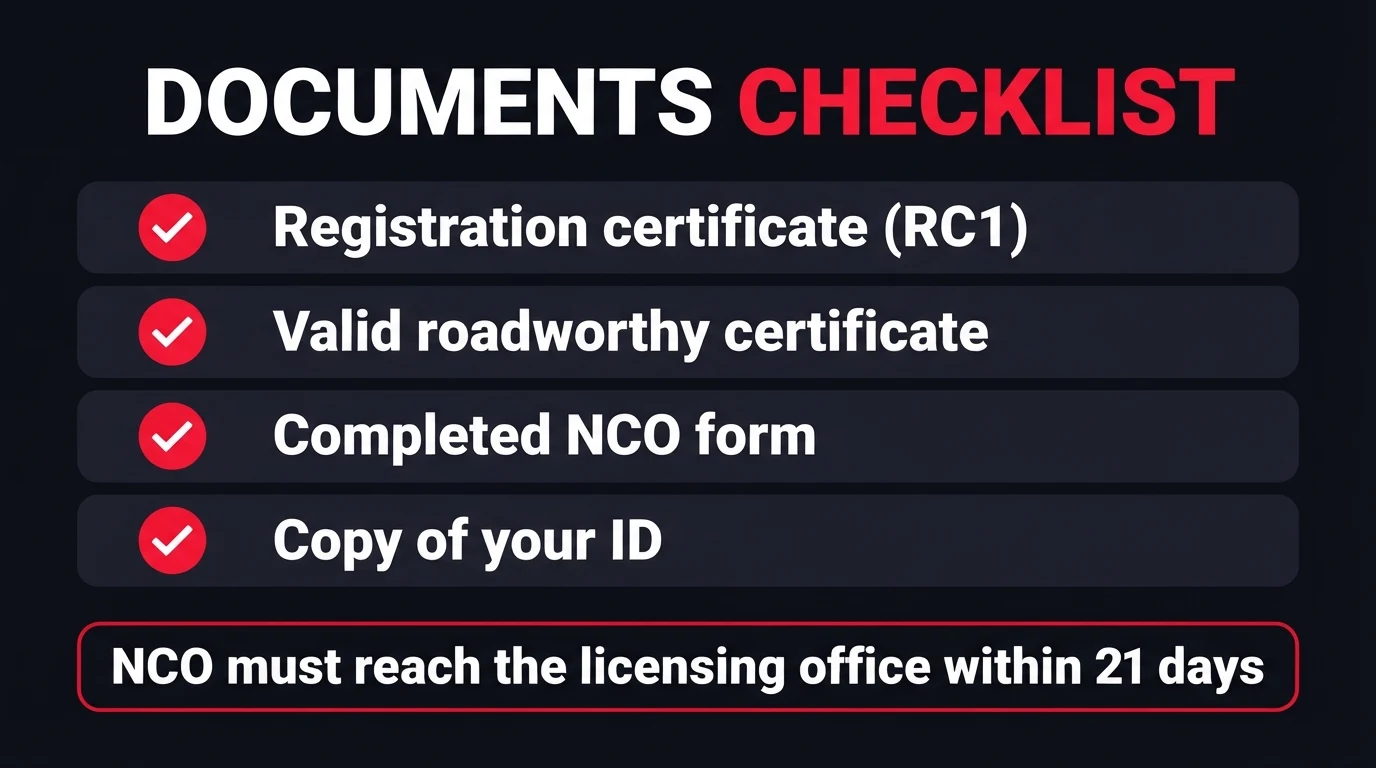
You'll need four documents to sell a car privately in South Africa: the registration certificate (RC1), a valid roadworthy certificate, a completed NCO form, and a copy of your ID. The buyer must also submit their own RLV form and ID within 21 days of the sale — miss that step on either side and the ownership transfer stays open.
Last updated 24 August 2026
- Registration certificate (RC1)
- Proof of ownership. You already have it — hand the original to the buyer at the sale.
- Roadworthy certificate
- Legally required before transfer completes. Valid for 60 days from the date it's issued.
- NCO form
- The seller's notification of change of ownership. Free, and must reach the licensing office within 21 days.
- Roadworthy cost
- R300–R850 for a private passenger car, more for SUVs and bakkies, as of August 2026.
- Lost registration certificate
- Apply for a duplicate with the DRC and DCT forms at your registering authority — up to 7 working days.
- The document most people forget
- The roadworthy certificate — sellers assume the registration papers and ID are enough. They aren't.
Most private car sales in South Africa don't fall apart over price. They stall at the licensing counter, weeks after the money has already changed hands, because one document wasn't sorted before the buyer drove off. Here's exactly what you need, what each one costs, and the one trap that keeps fines landing in your name long after the car is gone.
What four documents do you actually need to sell a car privately?
Picture this: a buyer is standing in your driveway with an EFT confirmation on their phone, ready to pay right now — and you're digging through a drawer for a form you didn't know you needed. That's the moment this list is for.
-
The registration certificate (RC1)
This is your proof of ownership. Hand the original to the buyer at the point of sale — never a photocopy, and never before the money has cleared.
-
A valid roadworthy certificate
Required by law for the transfer to complete. Get it tested close to the sale date, since it's only valid for 60 days from issue.
-
A completed NCO form
Notification of Change of Ownership — your form as the seller, with the vehicle details, both parties' details, and both signatures.
-
A copy of your ID
Attached to the NCO when you submit it. The buyer submits a copy of their own ID with their separate form.
| Document | Who supplies it | What it costs | How long it takes |
|---|---|---|---|
| Registration certificate (RC1) | Seller (already holds it) | Free, if not lost | Instant — hand it over |
| Roadworthy certificate | Seller arranges, or split with the buyer | R300–R850 (passenger car) | Same day at most testing stations |
| NCO form | Seller completes and submits | Free | Same day, at a DLTC or licensing office |
| Copy of ID | Seller and buyer, each their own | Free | Instant |
| Duplicate RC1 (if lost) | Seller, via the registering authority | Typically R150–R250, confirm locally | Up to 7 working days |
| RLV form (buyer's) | Buyer completes and submits | Fees vary by province | Processed same day, per gov.za |
What is the NCO form, and why does it matter more than people think?
The NCO — Notification of Change of Ownership — is the form that tells the licensing authority the car is no longer yours. As the seller, you complete it with the vehicle's registration number, VIN and engine number, your details and the buyer's, and both of you sign.
You then have 21 days from the date of sale to get it to your local licensing office, along with a copy of your ID. It's free. The buyer separately submits the RLV (Application for Registration and Licensing) form with the registration certificate and roadworthy certificate, also within 21 days.
Do you need a roadworthy certificate to sell your car privately?
Yes. By law, the licensing department will not release the new owner's licence disc without one. You can technically transfer ownership without a valid roadworthy on the day, but the buyer then has 21 days to produce one before the disc is withheld — and a roadworthy is only valid for 60 days from the date it's issued, with no extensions.
Expect to pay R300 to R850 for a private passenger car, and more — R500 to R1 000 — for an SUV or bakkie, as of August 2026. Prices differ between testing stations, so it's worth a quick call around if you're price-sensitive.
Sellers who leave it until a deal is on the table often find their car doesn't pass first time — tyres, brakes and lights are the most common failures — and a re-test is R150 to R250 and a delay. Get it tested early, and the sale doesn't stall on you at the worst possible moment.
What happens if you've lost the registration certificate?
Apply for a duplicate at your registering authority using the DRC (Application for Duplicate Registration/Deregistration Certificate) and DCT (Declaration in Respect of Lost Documents) forms. You'll need your ID and proof of residential address.
Only the titleholder can apply — if the car is still financed, that's the bank, not you, and you'll need to go through them first. Processing can take up to seven working days, so this is not something to discover the week you want to sell.
What is the licence-disc and eNaTIS trap that leaves fines in your name?
Until your NCO form is captured, the car stays registered to you on eNaTIS — the National Traffic Information System. That means any fine, e-toll bill, or traffic offence the new owner racks up can keep showing up against your name and your ID, sometimes for years, until the change of ownership is actually processed.
This is the part almost everyone underestimates: the risk doesn't end when the money clears. It ends when the NCO form is stamped, submitted and captured at the licensing office — so treat that 21-day window as part of the sale, not an afterthought.
What documents does the buyer need to bring?
Their own ID, and their completed RLV form — submitted with the registration certificate and the roadworthy certificate you've handed over, within 21 days of buying. It's worth telling a private buyer this upfront; a buyer who doesn't know the clock is running is a buyer who might come back to you confused a month later.
Not sure which registering authority to use, or whether a specific document applies to your sale? Contact us and we'll talk you through it — it costs nothing and saves a wasted trip to the counter.
The short version
- Four documents — RC1, roadworthy certificate, NCO form, your ID.
- 21 days to submit the NCO, from the date of sale — it's free.
- Roadworthy is legally required, valid 60 days, R300–R850 for a passenger car.
- Lost the RC1? DRC + DCT forms, titleholder only, up to 7 working days.
- Until the NCO is captured, fines and offences can still land in your name.
Frequently asked questions
What documents do I need to sell my car privately in South Africa?
Four documents: the registration certificate (RC1), a valid roadworthy certificate, a completed NCO form, and a copy of your ID. The buyer also needs to submit their own RLV form and ID within 21 days of the purchase.
Do I need a roadworthy certificate to sell my car privately?
By law, yes. The licensing department will withhold the new owner's licence disc until a valid roadworthy certificate is produced, and the buyer has 21 days to produce one. A roadworthy is valid for 60 days from issue, so time it close to the sale, not months ahead.
What is the NCO form and who has to submit it?
The NCO (Notification of Change of Ownership) is the seller's form. It must reach your local licensing office within 21 days of the sale, along with a copy of your ID and the buyer's details. It's free, and it's what removes you from liability for anything that happens with the car afterwards.
What happens if I've lost my car's registration certificate?
Apply for a duplicate at your registering authority using the DRC and DCT forms, with your ID and proof of address. Only the titleholder can apply — if the car is financed, that's the bank, not you. Processing can take up to seven working days, so start this before you have a buyer waiting.
How long do I have to notify the change of ownership after selling my car?
21 days from the date of sale for the seller's NCO form, and separately 21 days from the date of purchase for the buyer's RLV form. Both clocks start on the sale date, not the date the paperwork happens to reach the counter.
What happens if I don't submit the NCO form in time?
The vehicle stays registered in your name on eNaTIS until the change is processed. Traffic fines, e-tolls and even offences committed by the new owner can keep landing against your name and your ID until the NCO is filed and captured.
Can I sell my car without a roadworthy certificate?
You can transfer ownership without one, but the buyer won't get a licence disc until a valid roadworthy is produced within 21 days. In practice, arrange the roadworthy before the sale — it avoids the deal stalling at the licensing counter and it's a fair thing for a buyer to expect.
Selling and want the paperwork off your plate?
A trade-in with Tembani Sales skips the NCO queue, the roadworthy scramble and the 21-day wait — get a free evaluation and we handle the rest.
Selling to upgrade? The Lepas L6 is one of the more popular next cars at a similar price point on our floor.