

Dealers value a trade-in from five inputs: the car's book trade value, its condition, its mileage against its age, its service history, and how quickly it will resell. The offer sits below the retail price because the dealer pays to recondition the car, carries it on the floor, and owes the next buyer a six-month warranty.
Last updated 5 October 2026
- Starting point
- A book trade value for that make, model, year and variant. In South Africa the standard reference is TransUnion.
- Checking it yourself
- A TransUnion Car Value Report costs R25 (as of October 2026) and gives a trade and retail range.
- What adjusts it
- Condition, mileage for the car's age, service history, and how fast that car will resell.
- Why it is below retail
- Reconditioning, holding costs, the dealer's margin, and the Consumer Protection Act's six-month implied warranty.
- What you can change this week
- Cleanliness, a complete service record, both keys, and small faults you already know about.
- What you cannot change
- The year, the mileage, and how popular the model is with buyers right now.
Most people walk into a trade-in thinking the dealer pulls a number out of the air. It is closer to a formula than it looks. Once you know the inputs, you can see which ones you control and stop wasting money on the ones you do not.
What number does a dealer start from?
The book trade value for your exact make, model, year and variant. In South Africa, the standard reference is TransUnion, which publishes both a trade value and a retail value for most mainstream cars.
According to TransUnion's Car Value Report FAQ, it collects raw sales data from hundreds of dealers every month, which is then analysed and verified before values are published. That is why the trade number is a fair place to start: it reflects what dealers are really paying.
It is also given as a range, not a single figure. TransUnion says regional popularity, supply and demand, and how the car was used all move the value. Where your car lands in that range is what the rest of this guide is about.
| Value | What it means | Where you will see it |
|---|---|---|
| Trade value | Roughly what a dealer pays for the car | Your trade-in or buy-in offer |
| Retail value | Roughly what a buyer pays a dealer for it | A dealer's selling price |
| Advertised price | What a seller is asking, not what it sold for | Classifieds and Marketplace listings |
| Insurance value | The insurer's figure, adjusted for actual condition at claim time | Your policy or a claim |
Source: TransUnion South Africa, Car Value Report FAQ, opened 5 October 2026. TransUnion only publishes values for cars that have been on sale for more than 12 months, sold in enough volume, and are no older than 25 years.
Driving something brand new to South Africa, or rare? There may be no book value yet. The dealer then works from recent sales of that model and its nearest rivals, which is why newer Chinese models can get very different offers from different dealers. Our guide to whether Chinese cars hold their value covers this.
Which five things actually move your trade-in offer?
Book value, condition, mileage, service history and demand. The first sets the range. The other four decide whether you land at the top of it, in the middle, or below it.
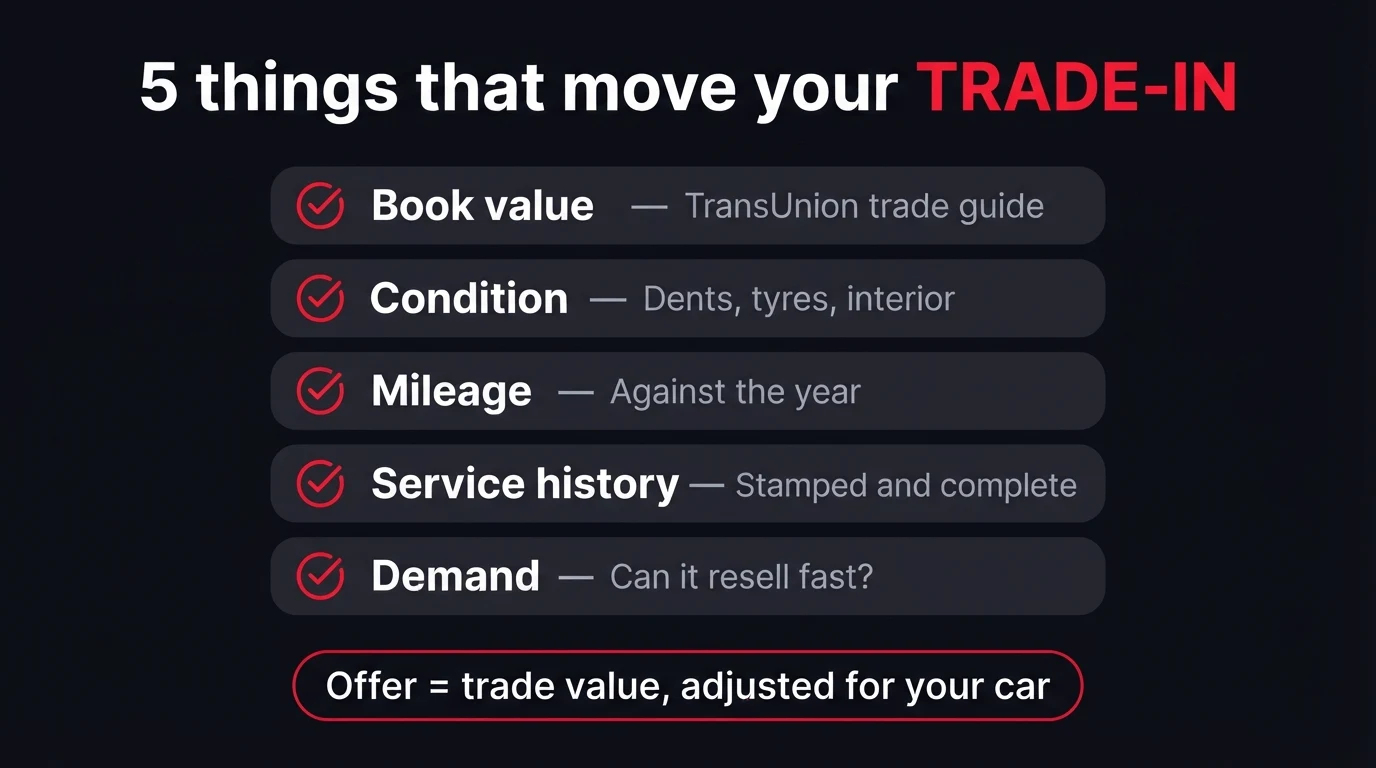
| Factor | What the dealer checks | Can you change it? |
|---|---|---|
| Book value | Make, model, year, variant | No |
| Condition | Panels, paint, glass, tyres, interior, warning lights, how it drives | Partly |
| Mileage | Kilometres on the clock compared with the car's age | No |
| Service history | Stamps, invoices, and proof of the big jobs | Partly: find the records |
| Demand | How quickly that model, colour and gearbox will resell | Only by choosing when to sell |
Condition: every fault is priced at the dealer's cost to fix it
The dealer walks around the car, looks underneath and drives it. Each problem found is deducted at roughly what it will cost them to put right, plus some margin for what they cannot see yet.
That is why undisclosed damage hurts more than disclosed damage. A scratch you mention up front is a scratch. A scratch the dealer finds makes them wonder what else you did not mention.
Mileage: judged against the year, not on its own
A five-year-old car with very high kilometres drops towards the bottom of the range, and so can a very low-mileage car with no records to prove it. What the dealer wants is mileage that makes sense for the age, backed by paperwork.
Demand: what the next buyer wants decides what you get
The dealer is really asking one question: how fast can I resell this? A popular model in a mainstream colour with the gearbox most buyers want turns over quickly. A slow seller costs the dealer money every week it stands, and that cost comes off your offer.
What is a full service history actually worth in rands?
Roughly the cost of the most expensive job the dealer cannot prove was done. There is no honest single rand figure for every car. A missing history does not lower the value by a fixed amount; it makes the dealer assume the worst about each gap and price that in.
So the real question is not "how much is a service book worth?" It is "what does the dealer have to assume without it?"
| What is missing | What the dealer has to assume |
|---|---|
| Proof of a cambelt or timing-belt change (where the engine has one) | It is due, so the cost of doing it comes off your offer |
| Gaps between service stamps | Oil changes were skipped, so there is more engine risk |
| No service book at all | The car is harder to retail, so it is worth less to them |
| Stamps but no invoices | Usually fine, but invoices settle any doubt about what was done |
The good news: lost records can often be recovered. The workshop or dealership that did the work can usually print or email a service history against your VIN or registration. Ask before you go in for a valuation.
Why is your trade-in offer lower than the car's retail price?
Picture this: you look up your car on a classifieds site, see similar ones advertised for far more than the dealer just offered you, and feel robbed.
Here is the honest answer. The gap between trade and retail pays for real costs, and an advertised price is an asking price, not a selling price. Some of that gap is margin. Most of it is everything the dealer must spend before and after the next buyer drives away.
| Where the gap goes | Why it exists |
|---|---|
| Reconditioning | Valet, paint and panel touch-ups, tyres, a service if one is due |
| Roadworthy | A roadworthy certificate is needed to register the car to the next owner |
| Holding costs | Floor space, stock finance and insurance while it waits for a buyer |
| Warranty risk | The dealer owes the next buyer a six-month implied warranty under the Consumer Protection Act |
| Margin | The dealer's profit, which also covers cars that sell at a loss |
The warranty is the part most sellers never think about. Under section 56 of the Consumer Protection Act, goods sold by a business carry an implied warranty of quality for six months, as the Retail Motor Industry Organisation explains. A private seller who sells voetstoots carries none of that risk. A dealer carries all of it.
Classified adverts show what sellers hope to get, often after weeks of no calls. Compare a dealer offer with the trade value range, or with other dealer offers on the same day. If you want the private-sale number instead, weigh it properly in our guide to trade-in vs selling privately.
Should you fix anything before you trade in?
Only where the dealer would deduct more than the fix costs you. Cheap, visible things usually pass that test. Big repairs and cosmetic upgrades almost never do, because a dealer pays trade prices for parts and labour and you pay retail.
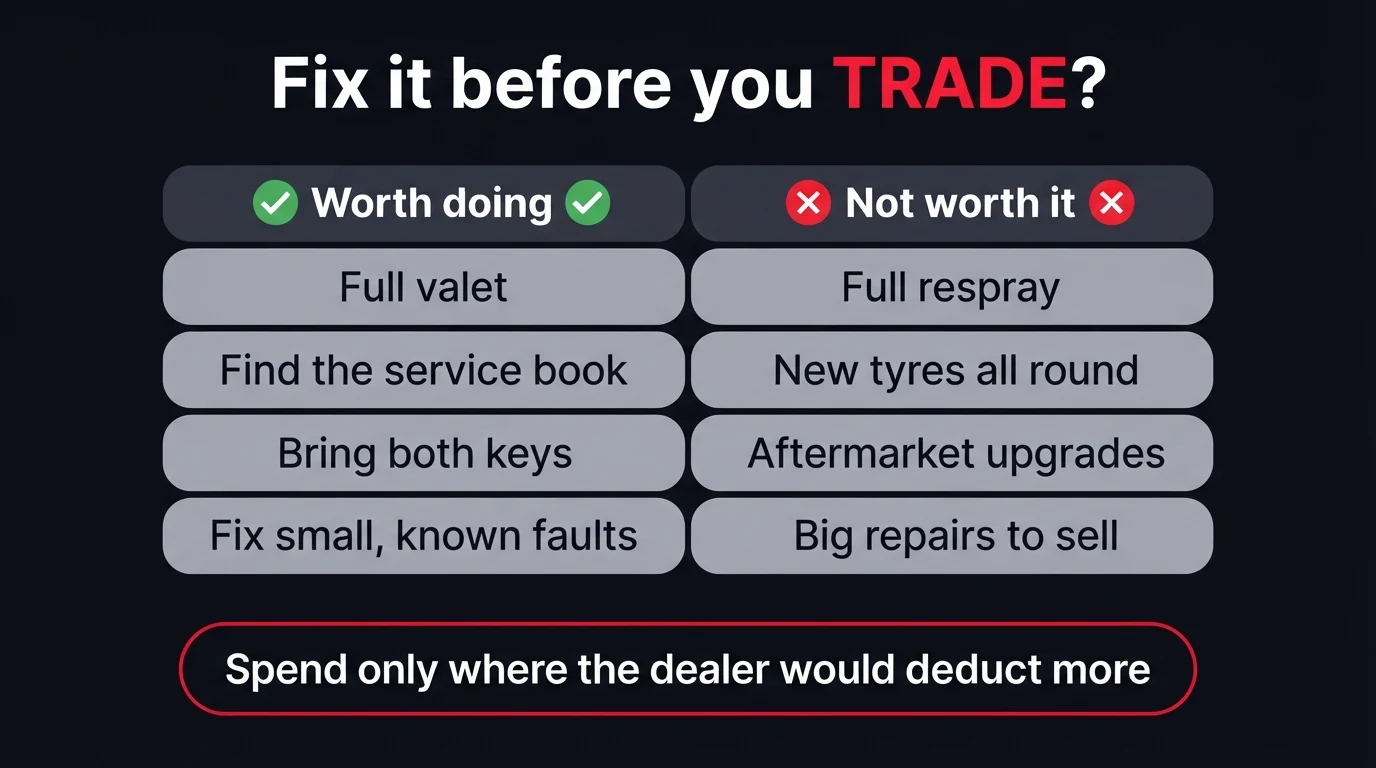
Worth doing before a valuation:
- A proper clean, inside and out. It will not add book value, but a dirty car makes a dealer assume it was neglected.
- Find the service book and invoices. This is the cheapest money you will ever make on a car.
- Bring both keys. A missing spare means the dealer has to source and code a new one, and that comes off your offer.
- Fix small faults you already know about, like a blown bulb or a missing hubcap, if the fix is quick and cheap.
Usually not worth it:
- A full respray or major panel work. You will rarely get the money back.
- New tyres all round. The dealer buys tyres at trade prices, so the deduction is usually smaller than your bill.
- Aftermarket upgrades. Big rims and sound systems rarely add value and can narrow the pool of buyers.
- Big mechanical repairs just to sell. Disclose the fault and let the dealer price it.
One exception: a warning light on the dash. An unexplained light makes a dealer assume the worst. A diagnostic scan that names the problem can turn an unknown into a known, and a known fault is cheaper to the dealer than a guess.
What should you bring to get the best trade-in offer?
Everything that proves what the car is and how it was looked after. A complete pack makes the valuation faster and removes the reasons to knock the number down.
| Bring | Why it matters |
|---|---|
| Your ID | The dealer must confirm who is selling the car |
| Vehicle registration certificate | Proves ownership and shows if a bank is the titleholder |
| Service book and invoices | The single biggest thing you control on value |
| Both keys | Avoids a deduction for a replacement key |
| Settlement letter (if financed) | Shows exactly what is owed so the deal can settle your bank |
| Spare wheel, jack and tools | Missing items are another small deduction |
Still paying the car off? That is normal, and it does not stop a trade-in. The dealer settles your bank directly. Our guide to selling a car that still has finance on it explains settlement letters and what happens if you owe more than the car is worth.
How does Tembani Sales value a trade-in?
A WhatsApp estimate first, then a 15-minute inspection to confirm it. Send us the make, model, year, mileage and a few photos through the free trade-in valuation form or on WhatsApp, and Tembani sends an initial figure back to your phone, usually the same day.
You then bring the car to Park Meadows in South Kensington for a quick physical check. If it matches what you described, the number should hold. If the inspection finds something that was not mentioned, ask exactly what changed and why, and get the final offer in writing before you agree to anything.
After that, you choose: an EFT to your account, or put the value towards a car from the showroom, such as the Chery Tiggo Cross LiT. We buy cars outright too, even if you are not buying from us.
The short version
- Dealers start from the book trade value for your make, model, year and variant.
- Condition, mileage, service history and demand decide where you land in that range.
- A full service history is worth whatever the dealer would otherwise have to assume and deduct.
- Trade is below retail because of reconditioning, holding costs, margin and the six-month CPA warranty.
- Spend money only where the deduction is bigger than the fix: clean it, find the records, bring both keys.
- Compare offers with the trade range, not with advertised prices.
Frequently asked questions
How do dealers work out a trade-in value?
They start from the book trade value for the car's make, model, year and variant, which in South Africa usually means TransUnion. Then they adjust it for condition, mileage against the car's age, service history, and how quickly that car will resell. Reconditioning costs and the dealer's margin come off before the final offer.
Is the TransUnion value what a dealer will offer me?
Not exactly. TransUnion gives a trade value as a range for that model, not a price for your specific car. Your offer depends on where your car sits in that range once condition, mileage, service history and local demand are taken into account. Use the range as a sense check, not a promise.
Does a full service history increase trade-in value?
Yes. Without proof of servicing, a dealer has to assume work was skipped and deduct the cost of the jobs it cannot verify, such as a cambelt change where the engine has one. A complete stamped book with invoices removes those deductions. If records are missing, ask the workshop that serviced the car for a printout.
Should I fix dents and scratches before trading in my car?
Usually not, unless the repair is small and cheap. A dealer repairs panels at trade cost, so the amount deducted from your offer is often less than you would pay a panel beater. A thorough valet, the service records and both keys are a much better use of your money before a valuation.
Why is a dealer's trade-in offer lower than the retail price?
Because the dealer must recondition the car, get a roadworthy for the next registration, pay to hold it until it sells, and carry the six-month implied warranty the Consumer Protection Act gives the next buyer. The remaining gap is the dealer's margin. Advertised prices are also asking prices, not what cars actually sell for.
Can I trade in a car that still has finance on it?
Yes. Bring a settlement letter from your bank, and the dealer settles the bank directly as part of the deal. If the trade-in value is more than you owe, the difference goes to you or towards your next car. If it is less, you need to cover the shortfall in cash or through your next finance agreement.
How long does a trade-in valuation take at Tembani Sales?
Send the car's make, model, year, mileage and photos on WhatsApp or through the trade-in form, and you will usually get an initial figure the same day. The car then needs a quick 15-minute physical inspection at Park Meadows in South Kensington, Johannesburg, to confirm the offer before you are paid or trade in.
Want your real number, not a guess?
Send us your car's make, model, year, mileage and a few photos. Tembani will come back with an initial trade-in figure, usually the same day, so you know where you stand before you decide anything.
Trading up? Apply for finance on your next car at the same time.