

Yes, you can sell a car that still has finance, but the bank must be paid first. Ask your bank for a written settlement letter, then either trade it in (the dealer settles the bank directly), have a private buyer pay the bank, or settle it yourself. If the car is worth less than the settlement, you pay the difference.
Last updated 2 October 2026
- Can you sell it?
- Yes, but the bank is the titleholder until the account is settled, so it must be paid before ownership can pass.
- First document
- A written settlement letter from your bank, showing the amount to settle and the date it is valid until.
- What the settlement includes
- Outstanding capital, interest and fees up to the settlement date, plus any balloon still owing.
- Early settlement penalty
- None on agreements up to R250 000. Above R250 000, a charge of up to three months' interest is allowed.
- Simplest route
- A dealer trade-in: the dealer pays the bank directly and handles the settlement paperwork.
- If you owe more than it is worth
- You pay the shortfall in cash, or it is added to your next car loan if a bank approves it.
Picture this: you have found a buyer, agreed a price, and they want to pay tonight. Then you look at your registration certificate and see your bank's name in the titleholder field. That one line changes the whole order of the sale.
Can you sell a car that still has finance on it?
Yes, but not without the bank. While you owe money on the car, the bank is recorded as the titleholder. You are the owner, you drive it and you are responsible for it, but the bank has the legal right to it until the debt is paid.
That means ownership cannot pass cleanly to a buyer until the account is settled. Every legitimate route below is just a different way of getting the bank paid first.
Buyers know this too. A careful buyer will check the titleholder field before paying, exactly as we explain in how to check if a car is stolen or has finance owing. Being upfront about it earns trust instead of losing the sale.
Why is your settlement figure not the balance on your statement?
Because the settlement figure is calculated for a specific date. It adds up the capital you still owe, the interest up to that day, and any outstanding fees. Your monthly statement is a snapshot that is already out of date.
The National Credit Act says you can settle a credit agreement at any time. What you pay depends on the size of the agreement, as summarised in the National Credit Regulator's consumer guide to the Act.
| Size of credit agreement | Early settlement charge allowed |
|---|---|
| Up to R15 000 (small) | None |
| R15 001 to R250 000 (intermediate) | None |
| Over R250 000 (large) | Up to three months' interest, reduced by any notice you give |
Source: National Credit Regulator consumer guide to the National Credit Act, section 125. As of October 2026. Your bank's settlement letter is the final word on your number.
Have a balloon payment on the loan? It is part of what you owe, so it is inside the settlement figure. That is often why the number is higher than people expect. Our guide to balloon payments shows how much it adds.
How do you get a settlement letter?
Ask your bank's vehicle finance division for it, in writing. Have your account number and ID ready. The letter should show the settlement amount, the account to pay it into, the reference to use, and a valid-until date.
That date matters. Interest keeps running, so the figure only holds until the date printed on it. If the sale slips past that date, get a fresh letter before any money moves.
Only pay a settlement into the account named on the bank's own letter, and confirm it with the bank directly. Never use banking details someone forwards to you in a message.
What are your three routes to selling a financed car?
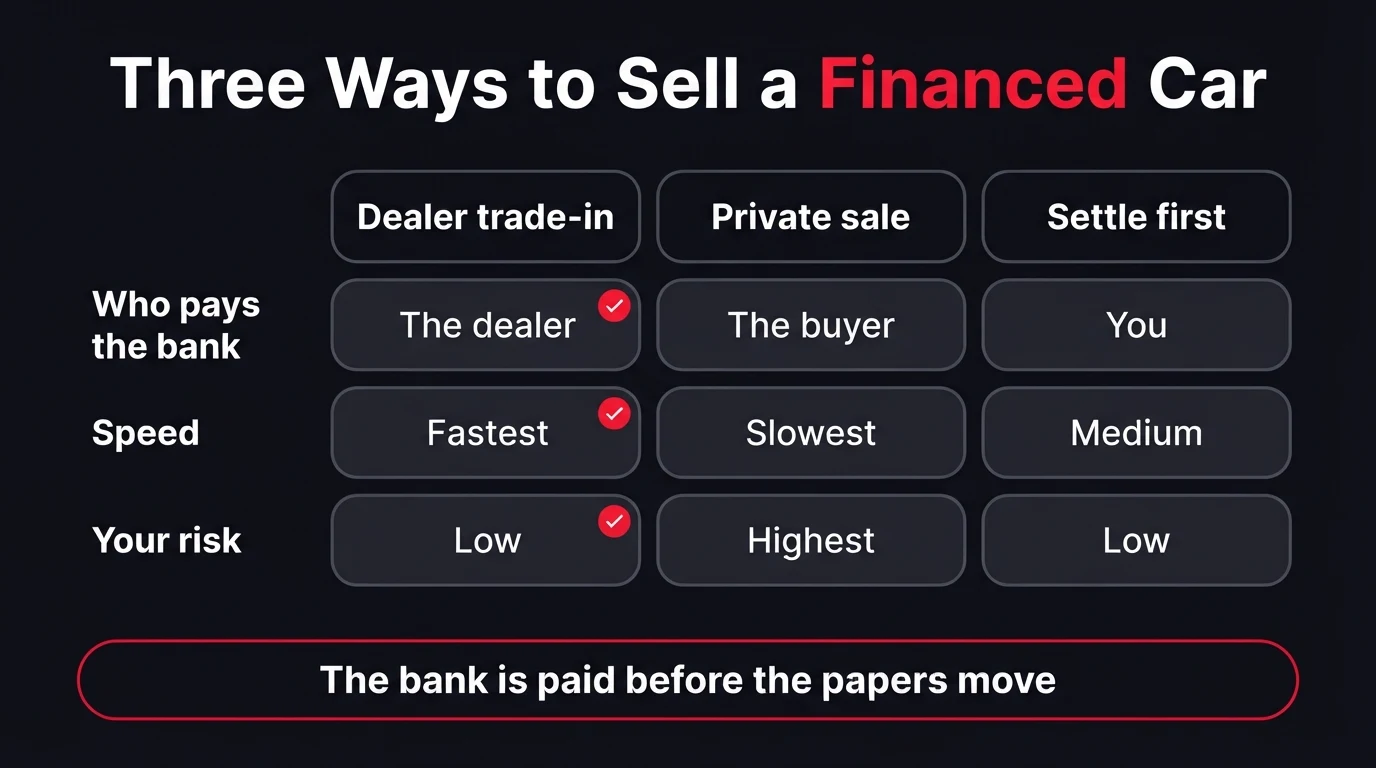
Trade it in, sell privately with the bank in the loop, or settle it yourself first. All three end the same way: the bank is paid, then the papers move. They differ in who pays the bank, how fast it goes, and how much risk sits with you.
| Route | Who pays the bank | Best for | Main catch |
|---|---|---|---|
| Dealer trade-in or sale | The dealer, directly | Speed and the least admin | Usually less than a top private price |
| Private sale, bank in the loop | The buyer, into the bank's account | Getting the highest price | Slowest, and buyers are nervous |
| Settle first, then sell | You, from your own money | Sellers with cash available | You need the full settlement upfront |
Route 1: Trade it in or sell it to a dealer
The dealer pays your settlement straight to the bank. If the car is worth more than you owe, the difference is paid to you or goes towards your next car as a deposit. You hand over the settlement letter and the keys.
The trade-off is price. A dealer has to recondition and resell the car, so the offer is usually below what a patient private seller might get. You are paying for speed and for not managing the bank yourself.
Route 2: Sell privately with the bank in the loop
The buyer pays the settlement amount directly into your bank's account, and pays you any balance. The bank closes the account and releases its title. Ask your bank exactly how it handles a sale to a private buyer before you advertise.
This route gets the best price, but it is the slowest and the most fragile. Many private buyers are wary of paying a bank on behalf of a stranger, and the car cannot change hands until the bank confirms the account is settled.
Release the car only when your bank confirms the account is settled and any balance due to you shows as cleared funds. A proof-of-payment screenshot is not payment. Our guide to Facebook Marketplace car scams shows how this one plays out.
Route 3: Settle it yourself, then sell
If you have the cash, this is the cleanest private sale. You pay the bank, the title is released, and you sell a car with no finance against it.
Buyers relax when the papers are clean. The catch is obvious: you need the full settlement amount upfront, and you only get it back when the car sells.
What happens if you owe more than the car is worth?
You still owe the difference. This is called negative equity, and it is common on newer cars, long loans and loans with a balloon. Selling the car does not cancel the shortfall.
Here is a worked example. The figures are illustrative assumptions, not a quote or a market average.
| Worked example | Amount |
|---|---|
| Settlement figure from the bank | R212 000 |
| Best offer for the car | R185 000 |
| Shortfall you must cover | R27 000 |
You have three realistic ways to deal with a shortfall:
- Pay it in cash at the time of sale, so the bank is fully settled.
- Add it to your next car loan, if a bank approves you. You then pay interest on money for a car you no longer own.
- Keep the car a while longer and pay the loan down until the value and the settlement meet.
The National Credit Act lets you return the car to the bank. The bank then sells it and credits your account. If it sells for less than you owe, you must pay the shortfall within 10 days, and you do not control the selling price.
How do you sell a financed car, step by step?
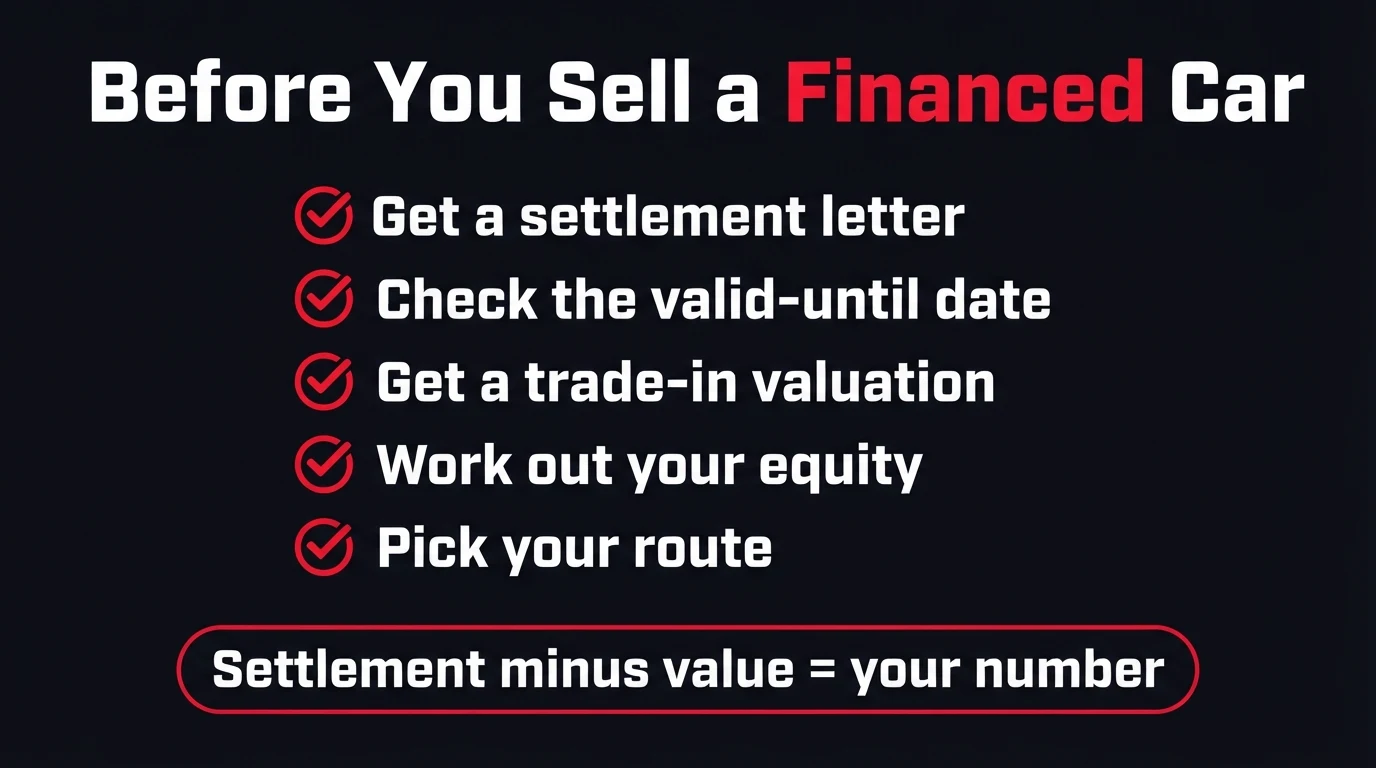
Get two numbers, compare them, then pick your route. Everything else follows from the gap between what you owe and what the car is worth.
- Get a settlement letter. Ask your bank for the settlement amount in writing, with the account to pay and the valid-until date.
- Get a valuation. Find out what the car is realistically worth today, from a dealer offer or comparable adverts.
- Work out your equity. Subtract the settlement from the value. A positive number is yours; a negative number is a shortfall you must cover.
- Choose your route. Trade in, sell privately with the buyer paying the bank, or settle first and then sell.
- Pay the bank, then do the papers. Once the bank confirms the account is settled, the change of ownership is registered with the licensing department.
Is a dealer trade-in really the easiest option?
For most people with finance owing, yes, but it is not automatically the best price. The dealer deals with the bank, the settlement letter and the timing, and a shortfall can be handled in the same deal instead of as a separate problem.
A private sale can make sense when you have healthy equity, time, and the patience to manage a nervous buyer. Our comparison of trade-in vs selling privately walks through both sides with the numbers.
Either way, start with a valuation. Send us your settlement figure with the car's details for a free trade-in valuation, and you will know whether you are ahead or short before you commit to anything.
What paperwork is needed once the finance is settled?
The bank releases its title, and the change of ownership is registered. The seller notifies the licensing department on the Notification of Change of Ownership (NCO) form, and the buyer registers the car in their name.
According to the government's guidance on changing owner or titleholder details, changes must be reported within 21 days. Fees are set by each province, so confirm them with your licensing department.
Ask your bank how long it takes to release the title after settlement, because the buyer cannot register the car until it does. The full process is in our guide to transferring car ownership in South Africa.
The short version
- You can sell a financed car, but the bank, as titleholder, is always paid first.
- Start with a written settlement letter, not your monthly statement.
- No early settlement penalty up to R250 000; above that, up to three months' interest.
- A dealer trade-in is the simplest route: the dealer pays the bank directly.
- If you owe more than the car is worth, the shortfall is still yours to pay.
- Never release the car until the bank confirms the account is settled.
Frequently asked questions
Can I sell my car privately if it is still under finance?
Yes, but the bank must be paid before ownership passes. Get a settlement letter, then have the buyer pay the settlement amount directly into the bank's account and pay you any balance. Only release the car once the bank confirms the account is settled. Ask your bank first exactly how it handles a sale to a private buyer.
How long is a settlement letter valid?
Only until the date printed on it. Interest keeps running on the loan, so the settlement amount is calculated for a specific date. If the sale or payment happens after that date, ask your bank for a fresh letter before any money moves, otherwise the payment may not fully settle the account.
Is there a penalty for settling car finance early?
Not if the agreement is R250 000 or less. Under the National Credit Act, there is no early settlement penalty on small or intermediate agreements. On large agreements over R250 000, the bank may charge up to three months' interest, reduced by any notice you give. Your settlement letter will show the exact amount.
Can I trade in a car with negative equity?
Yes. The dealer still settles your bank, but you must cover the shortfall between the trade-in value and the settlement. You can pay it in cash, or it may be added to the loan on your next car if the bank approves. Ask how much that adds to the new instalment before you agree.
What happens if I return the car to the bank?
The National Credit Act allows you to return the car. The bank sells it and credits the proceeds to your account. If the proceeds are more than you owe, the surplus is refunded to you. If they are less, you must pay the shortfall within 10 days, and you have no control over the selling price.
Does the settlement amount include the balloon payment?
Yes. A balloon payment is part of the money you still owe the bank, so it is included in the settlement figure. That is why settlement amounts on balloon loans are often much higher than people expect, and why negative equity is more common on them.
Who gets the papers after the bank is paid?
Once the account is settled, the bank releases its title so the car can be registered to the new owner. Ask your bank how it does this and how long it takes. The seller then submits the NCO form, and the change must be reported to the licensing department within 21 days.
Want to know if you are ahead or short?
Send us your settlement figure and your car's make, model, year and mileage. We will give you a trade-in valuation and settle the bank directly if you go ahead, so you know your real number before you decide.
Trading up? Apply for finance on your next car, or see the finance estimates on the Chery Tiggo Cross LiT page.