

To photograph a car so it sells, wash it, park it against a plain background in soft light, and crouch to headlight height with your phone in landscape. Take eight shots: both front and rear three-quarters, both sides, dashboard with odometer, seats, all four tyres, and the service book with the spare. Then photograph every bit of damage.
Last updated 17 October 2026
- Shots you need
- Eight core photos, plus a close-up of every dent, scratch or chip.
- Time it takes
- About one hour, including washing and emptying the car.
- Best light
- The first or last hour of sunlight, or open shade on an overcast day.
- Camera height
- Crouch so the phone sits level with the headlights, not at your eye level.
- Which lens
- The 1x main lens in landscape; step back instead of zooming or using 0.5x.
- Main listing photo
- The front three-quarter, with the front wheels turned slightly towards the camera.
Picture two listings for the same car at the same price. One has four dark phone snaps taken in a garage. The other has eight bright, level, clean photos. You know which one you would message.
Photos are the listing. Buyers decide whether to read your description, and whether to trust your price, from the thumbnail.
Which 8 photos should you take to sell a car?
Take these eight, in this order. Each one answers a question a buyer would otherwise ask you on WhatsApp, or worse, not ask and simply scroll past.
| # | Shot | What it proves to a buyer |
|---|---|---|
| 1 | Front three-quarter | The car's face and one full side in a single frame. This is your main photo. |
| 2 | Rear three-quarter | The back end is straight, with no bumper damage or mismatched paint. |
| 3 | Driver side, full | Panels line up and the side has no dents hiding in the reflections. |
| 4 | Passenger side, full | You are not hiding the damaged side. Buyers notice when one side is missing. |
| 5 | Dashboard and odometer | The mileage you wrote is real, and no warning lights are on. |
| 6 | Front seats and rear seats | No tears, stains or sagging bolsters, and the car has been looked after. |
| 7 | All four tyres | How much tread is left, and whether the tyres match. |
| 8 | Service book and spare | The car has a history, and the boot has a spare wheel and jack. |
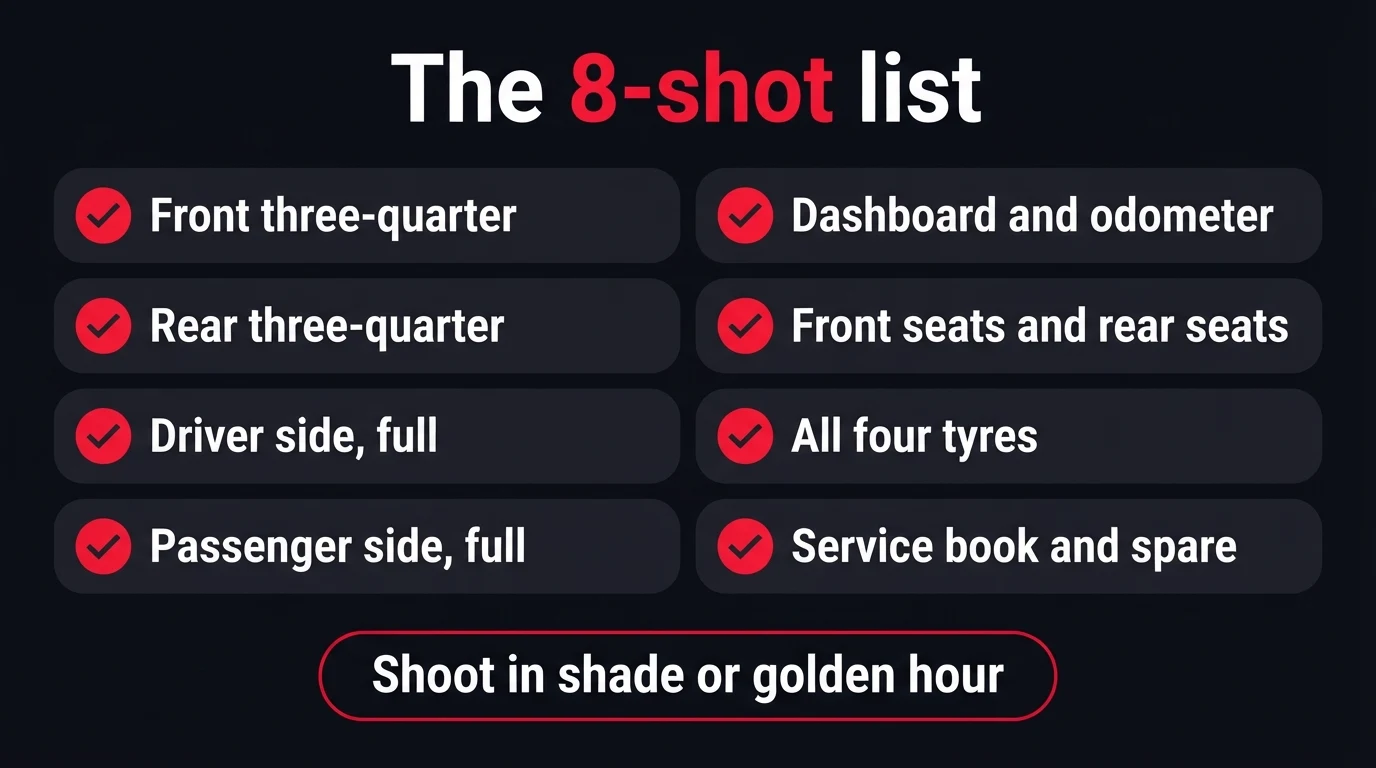
Then add the honest ninth: a close-up of every bit of damage. More on that below, because it is the shot most sellers skip and the one that saves the most arguments.
What time of day is best for car photos?
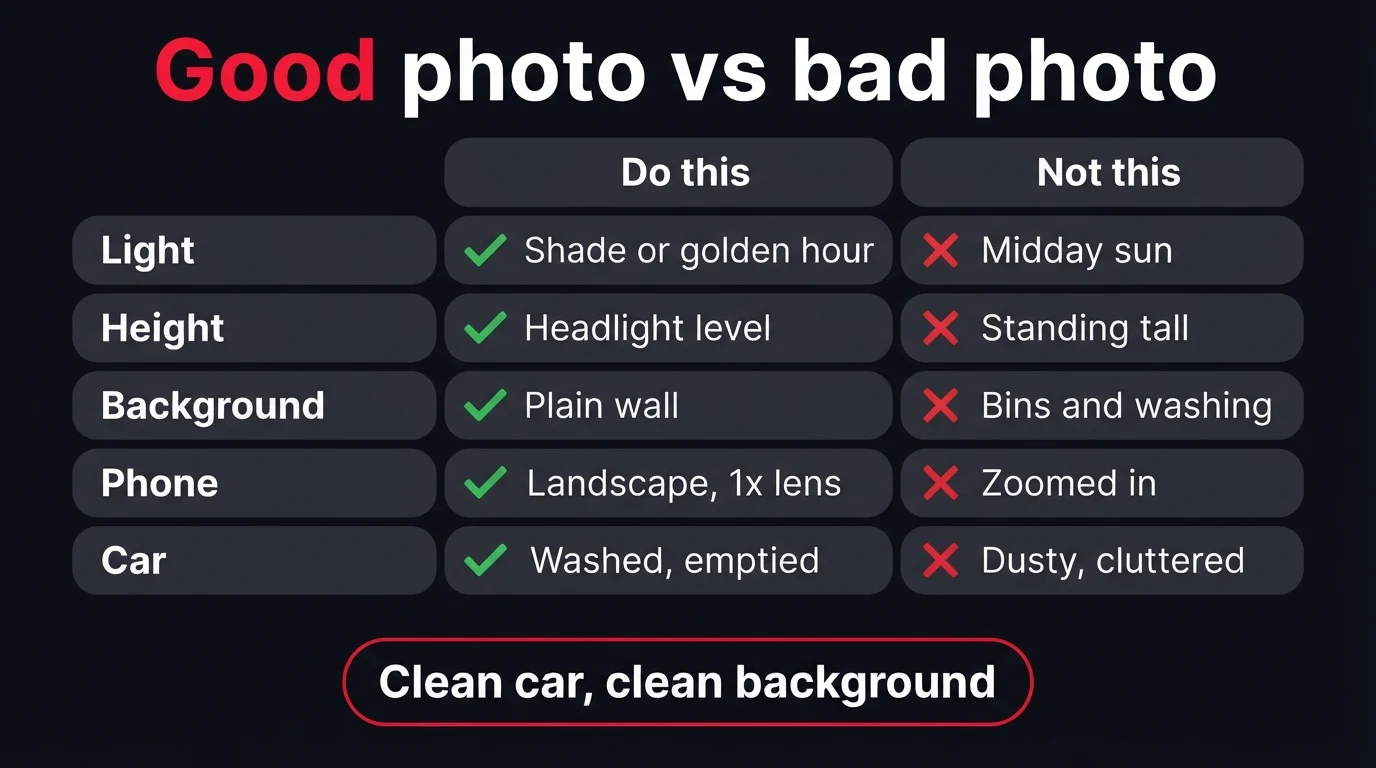
The first hour after sunrise or the last hour before sunset. On an overcast day, any time works, as long as the car is in open shade.
Highveld midday sun is the enemy. It bleaches the paint, throws a hard black shadow under the car, and makes every swirl mark and small scratch look twice as bad.
Avoid dappled shade under a tree, too. The blotchy light and shadow looks like marks on the paint.
Quick test: if you can see your own shadow sharply on the ground, the light is too hard. Wait, or move the car.
What angle and background actually make a car look good?
Crouch to headlight height and stand back far enough that the whole car fits with a little space around it. Shooting from standing height makes the car look small and squashed.
For the two three-quarter shots, stand at a front or rear corner so you see the face and one side together. Turn the front wheels slightly so the rim faces the camera, not the tyre tread.
For the background, pick a plain wall, an empty open space or a quiet level road. No bins, no washing line, no other cars, no ladders against the garage.
Keep your house number, gate, estate sign and street name out of every frame. A listing tells strangers there is a car worth having at that address. Meet buyers somewhere public, or let them come once you have vetted them.
How do you take the photos, step by step?
Set aside one hour and work through this in order. Most of the time goes into steps 1 and 2. The photos themselves are quick.
- Wash and empty the car. Wash it, vacuum it and take out everything personal: phone mounts, air fresheners, chargers, the gym bag in the boot.
- Move it to a plain background in soft light. Park in open shade or shoot in the first or last hour of sunlight, against a plain wall or an empty open space.
- Set up the phone. Wipe the lens, switch on gridlines, use the 1x main lens and hold the phone in landscape.
- Shoot the four outside angles. Front three-quarter, rear three-quarter and both full sides, crouched to headlight height.
- Shoot the inside. Dashboard with the ignition on so the odometer reads clearly, then the front seats and the rear seats.
- Shoot the proof. All four tyres, the boot floor with the spare wheel, and the stamped pages of the service book.
- Shoot the damage honestly. Every dent, scratch and chip, once close up and once from about two metres so the buyer can judge its size.
- Choose and order the photos. Lead with the front three-quarter, follow with the other outside angles, then interior, proof and damage.
Wiping the lens matters more than it sounds. A phone that lives in a pocket has a greasy lens, and that is where the soft, hazy look in most private listings comes from.
What should you photograph to build trust?
The boring things: the service book, the spare, the tyres and the boot. Glamour shots get the click. Proof shots get the viewing.
- Service book: open it to the stamped pages, so the dates and dealer stamps are readable. One photo of the cover proves nothing.
- Spare wheel and jack: lift the boot floor. A missing spare is a cost the buyer will deduct, so show it is there.
- Tyres: one photo per tyre, angled so the tread depth is visible. Matching brands on the same axle look cared for.
- Boot: empty, vacuumed, and with the parcel shelf in place.
- Both keys: if you have the spare key, photograph them together. Buyers ask.
If you are selling a car with a full or recent dealer service history, that photo deserves to sit in the first five.
What do buyers assume when a photo is missing?
The worst. A missing photo is not neutral. Buyers read it as something you chose to hide, and they either skip the listing or come in with a lower offer.
| Missing photo | What the buyer assumes |
|---|---|
| Odometer | The mileage is higher than stated, or the clock has been tampered with. |
| One full side | That side is damaged. |
| Interior | Torn seats, stains or a smoker's car. |
| Tyres | They need replacing, and the cost comes off your price. |
| Service book | There is no service history. |
| Dashboard with ignition on | A warning light is on. |
You cannot argue with an assumption you never hear about. The fix is to answer it with a photo before the buyer gets to wonder.
Should you photograph scratches and dents?
Yes, every one. Shoot each mark close up, then from about two metres so the buyer can see how big it really is.
A buyer who sees damage in the listing prices it in and still comes. A buyer who finds it at the viewing starts wondering what else you left out, and the conversation turns into a negotiation.
Honest photos also filter out time-wasters. The people who message you have already accepted the car as it is.
Is it worth doing all this, or should you just trade in?
It is worth it if you are selling privately. Good photos are the cheapest thing you can do to protect your asking price. But they are only one part of a private sale. You still have pricing, buyer vetting, viewings, payment and the NaTIS change of ownership to handle.
If that sounds like more than you want, a trade-in or a straight sale to a dealer skips all of it. The figure is usually lower than a good private sale, and you are trading the difference for speed and no risk. Our guide to trade-in vs selling privately lays out the trade-off honestly.
Either way, the same eight photos do double duty. Attach them to our free trade-in valuation form and we can give you a realistic first figure before we see the car, whether you want cash or want to swap into something from our showroom.
For a sense of what clean, consistent listing photos look like, compare the real floor photos in the live gallery on our Chery Tiggo Cross LiT page. If you are listing on Facebook, follow up with our step-by-step guide to selling a car on Facebook Marketplace.
The short version
- Eight shots sell a car: both three-quarters, both sides, dashboard and odometer, seats, all four tyres, and the service book with the spare.
- Soft light, low angle: golden hour or open shade, with the phone at headlight height in landscape on the 1x lens.
- Clean car, plain background, and none of your address in the frame.
- Photograph the damage. A missing photo makes buyers assume the worst.
Frequently asked questions
How many photos should I take to sell my car?
Take at least the eight core shots: front three-quarter, rear three-quarter, both sides, dashboard with odometer, seats, all four tyres, and the service book with the spare wheel. Add a close-up of every bit of damage. Fewer than eight leaves gaps, and buyers fill gaps with the worst assumption.
What is the best time of day to photograph a car?
The first hour after sunrise or the last hour before sunset, or any time in open shade on an overcast day. Avoid midday sun: it bleaches the paint, throws hard black shadows under the car and makes small scratches look worse than they are.
Should I hide my number plate in car photos?
Many private sellers cover or blur the plate, and it is a reasonable precaution because a clear plate in a public listing can be copied. A serious buyer will see the plate and check the VIN at the viewing anyway. What matters more is not showing your house number, gate or street sign.
Should I photograph scratches and dents on a car I am selling?
Yes. Photograph every dent, scratch and stone chip, once close up and once from about two metres. Buyers who see damage in the listing price it in and still come. Buyers who discover it at the viewing stop trusting everything else you said, and the negotiation gets harder.
Do I need a proper camera to take photos to sell a car?
No. A modern smartphone is enough if you use the 1x main lens, hold it in landscape, wipe the lens first and shoot in soft light. Light, angle and a clean background make far more difference than the camera. Avoid the 0.5x wide lens, which stretches the car.
Which photo should be the main photo on a car listing?
The front three-quarter: the car shot from a front corner, crouched to headlight height, with the front wheels turned slightly so the rim faces the camera. It shows the face and the side of the car in one frame, which is what a scrolling buyer decides on.
Can I send car photos to Tembani Sales for a trade-in valuation?
Yes. Our trade-in form lets you attach photos, or you can send them on WhatsApp with the make, model, year and mileage. The same eight shots in this guide are what we need to give you a realistic first figure before we see the car in person.
Took the photos? Get a number for them.
Send us the eight shots with the year and mileage, and we will come back with a realistic trade-in figure, so you know what your private asking price is up against.
This guide is general advice on photographing a car for sale, written as of October 2026. It is not a guarantee of any sale price or sale time.