
Yes, selling a car on Facebook Marketplace is reasonably safe if you control three things: who comes to see the car, where you meet them, and how the money moves. Get any one of those wrong and it becomes the least safe way to sell a car in South Africa. Most losses happen at the payment step.
Last updated 23 October 2026
- Risk 1: the person
- Vet every buyer before a viewing: profile age, full name, and a real phone call, not only chat messages.
- Risk 2: the place
- Meet in daylight at a busy, camera-covered public spot, such as a shopping-centre parking area or a police station's public parking, with someone else present.
- Risk 3: the money
- Release the car only once the payment shows as cleared funds in your own banking app — never on a screenshot, SMS or PDF.
- Test drives
- Photograph the buyer's licence and ID first, sit in the passenger seat yourself, and choose the route.
- Cheques
- Not an option: South African banks stopped accepting cheques from 31 December 2020.
- After the sale
- Submit the Notification of Change of Ownership (NCO) within 21 days so fines and licence renewals stop being yours.
Marketplace is where a lot of private car sales in Joburg now start. It's free, it's fast, and buyers are already scrolling. It's also an open door to strangers who know you have something worth a few hundred thousand rand.
The good news: almost every bad outcome follows the same short list of patterns. If you know them, you can close each one off before it costs you.
What actually makes selling on Marketplace risky?
Three things, and only three: the person, the place and the payment. The platform itself is just the noticeboard. Every scam or theft story we hear about comes down to the seller losing control of one of those three.
| Risk | What goes wrong | How you control it |
|---|---|---|
| The person | A fake profile, a "buyer" who is really scouting your car or your home, or someone who will never pay | Check profile age and history, get a full name, and insist on a phone call before you agree to meet |
| The place | A viewing at your house at night, or at a quiet address the buyer picked | You choose the spot: daylight, public, on camera, with someone else there |
| The payment | Fake proof of payment, a reversed transfer, an "overpayment refund", or a robbery when cash is involved | Cleared funds in your own banking app before keys, papers or signatures change hands |
How do you vet a Marketplace buyer before they see the car?
Ask for their full name and a phone call before you give out any meeting details. A genuine buyer gives both without fuss. Someone who only texts, dodges a call, and wants to skip straight to "send your banking details" is telling you something.
- Profile age: a brand-new profile with no photos, friends or history is the most common sign of a throwaway account.
- Real questions: serious buyers ask about mileage, service history and why you're selling. Scammers ask about price and payment.
- No address yet: share a general area until you've spoken. Your home address comes last, if at all.
- One buyer per slot: don't stack strangers back to back at the same spot.
Our step-by-step guide on how to sell a car on Facebook Marketplace covers the listing, pricing and photos side. This post is about keeping you and the car safe once the messages start.
Where should you meet a buyer?
Somewhere busy, well-lit and covered by cameras, in daylight, with someone you trust standing next to you. A shopping-centre parking area with security guards works. So does the public parking at a police station.
Avoid your home for the first viewing. A viewing tells a stranger where the car sleeps at night, and what else is parked next to it.
A genuine buyer won't argue with a public meeting point. Pushback on the venue is a warning sign.
Should you let a stranger test drive your car?
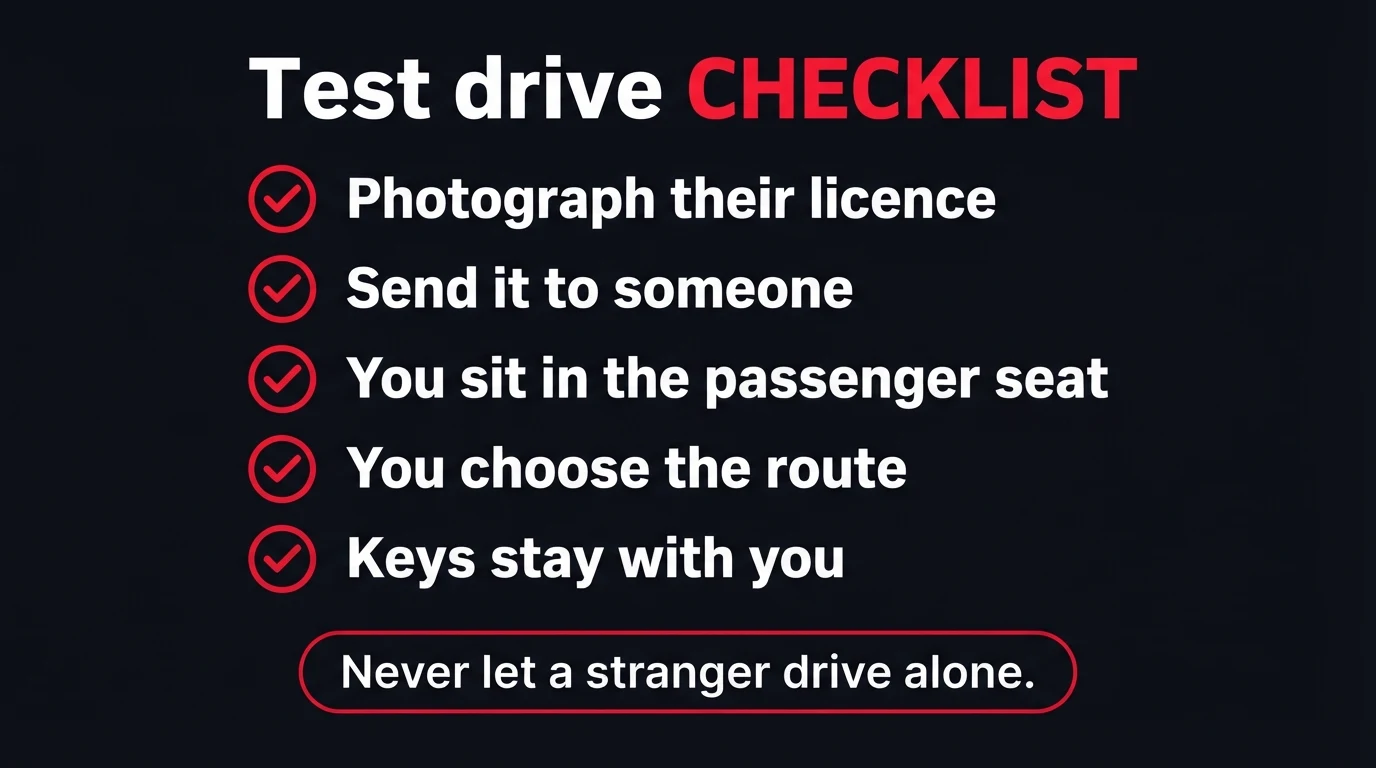
Yes, but never alone. Picture this: the buyer loves the car, asks to "just take it round the block", and you're standing on the pavement holding a phone. That is exactly how cars disappear. Here is the routine that stops it.
- Photograph their driver's licence and ID. Check the face matches the person in front of you, and that the licence is current.
- Send the photos to someone you trust before the drive starts, and tell the buyer you've done it. A thief walks away at this point.
- You sit in the passenger seat. You, or someone you trust, is in the car for the entire drive. No exceptions for "a quick spin".
- You choose the route. A short loop on roads you know, ending back at the meeting point.
- Keys stay with you until you're both seated, and come straight back to you when the drive ends. Never step out while the engine is running and the buyer is behind the wheel.
Check with your insurer before the viewing whether your policy covers someone else driving your car, and on what terms. Policies differ, and the time to find out is not after a buyer has kerbed a wheel.
Which payment methods are safe when you sell a car privately?
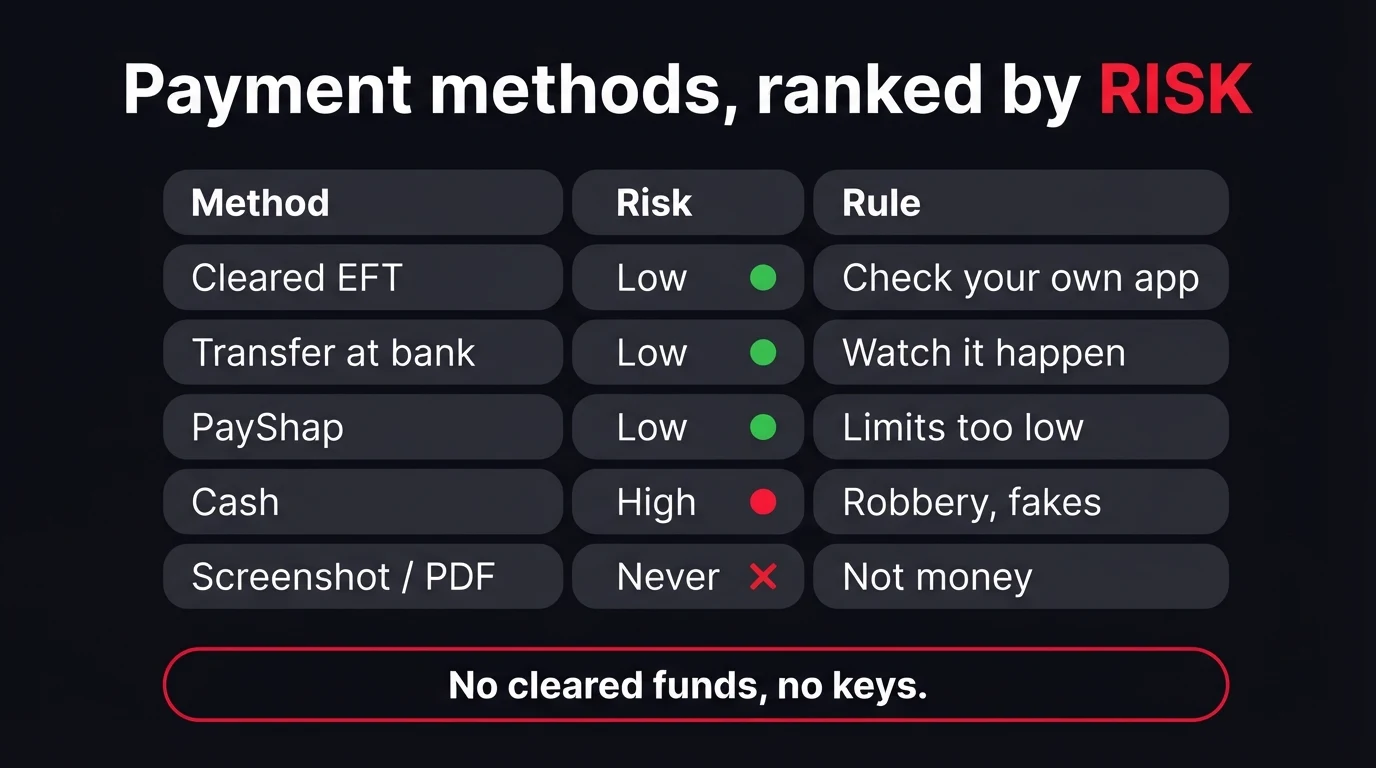
The only safe payment is money you can see as cleared funds in your own banking app. Everything else is a promise. Here's how the common options rank, as of October 2026.
| Method | Risk | The catch |
|---|---|---|
| Transfer made together at the buyer's bank branch | Lowest | Takes an appointment and a morning. You watch the payment being made, then confirm it in your own app. |
| EFT, confirmed as cleared in your own app | Low | Inter-bank transfers can take time to clear. Don't hand over keys until the balance has actually gone up. |
| PayShap | Low, but limited | Near-instant and banks say it can't be reversed — but per-payment limits are far below most car prices. |
| Cash | High | Counterfeit notes, and the risk of being robbed carrying a large amount. Only at a bank counter, deposited on the spot. |
| Cheque of any kind | Not possible | South African banks stopped accepting cheques from 31 December 2020. An offer of one is a red flag. |
| Screenshot, SMS or PDF "proof of payment" | Never accept | Edited in a minute. Even a genuine one doesn't mean the money has cleared. |
On cheques: the South African Reserve Bank's announcement confirmed that cheque issuing and acceptance ceased from 31 December 2020. There is no "bank-guaranteed cheque" route left in South Africa.
On PayShap: Nedbank's PayShap FAQs state that PayShap payments cannot be reversed, with a default limit of R5 000 per payment that can be raised to R50 000 with extra authentication. Other banks set their own limits — check yours.
A buyer "accidentally" pays you R20 000 too much and urgently asks you to send the difference back. The original payment was fake or reversible. Your refund is the only real money in the deal. Refund nothing until your bank confirms the funds are genuinely cleared.
What other seller scams should you know about?
Beyond fake proof of payment, three patterns come up again and again for sellers. Each one tries to move something — money, keys or information — before you've confirmed anything.
- "My driver will collect": the buyer never appears, a "driver" arrives with a payment screenshot. No cleared funds, no car.
- The OTP request: "I've sent the money, just read me the code your bank SMSed you." Never share an OTP — it authorises transactions on your account, and nobody needs it to pay you.
- The vehicle-check link: a buyer sends a link to "verify" your car or listing. It's built to harvest your login or card details. Close it.
Our rundown of Facebook Marketplace car scams in South Africa covers the buyer side too. If you've already been caught out, call your bank's fraud line first, then open a case at your nearest South African Police Service (SAPS) station.
Is selling privately worth it compared with a dealer?
Often, yes — a private sale usually gets you a higher number. What you give up is time, admin and the risk this whole post is about. A dealer gives you a lower figure, with none of that.
| Facebook Marketplace | Dealer trade-in or sale | |
|---|---|---|
| Price | Usually the higher number | Usually below a private sale |
| Strangers | You meet and vet them yourself | No stranger contact |
| Test drives | Your car, your risk | Not needed |
| Payment risk | On you to verify | The dealer pays you directly |
| Finance still owing | Complicated — the bank must be settled first | Handled as part of the deal |
| Paperwork | All on you, including the NCO | Handled for you |
The honest way to decide: get a real trade-in number first, then ask whether the private-sale premium is worth the viewings, the test drives and the payment risk. Our trade-in vs selling privately comparison walks through that maths.
If you're selling because you're buying, a trade-in also becomes your deposit on the next car — say, a new Chery Tiggo Cross LiT — in one transaction, with no stranger ever touching your keys.
What do you have to do once the car is sold?
Submit the Notification of Change of Ownership (NCO) at your licensing department within 21 days. Until it's processed, fines and licence renewals on that car stay linked to your name.
Keep a signed sale agreement, a copy of the buyer's ID, and the cleared payment from your own banking app. Our guide to the documents you need to sell a car privately has the full list. As of October 2026, confirm the current process with your licensing department, because procedures do change.
The short version
- It's safe if you control three things: the person, the place and the payment.
- Vet before you meet: full name, a real phone call, a profile with history.
- Meet in public, in daylight, on camera, with someone else there.
- Test drives: photograph their licence, ride along, choose the route.
- Cleared funds in your own app are the only payment that counts. No cheques, no screenshots, no refunds.
Frequently asked questions
Is Facebook Marketplace safe for selling a car in South Africa?
It can be, if you control three things: who comes to see the car, where you meet them, and how the money moves. Most bad outcomes come from skipping one of those, usually the payment step. Vet the buyer before you share your address, meet somewhere public with cameras, and only release the car once the money shows as cleared funds in your own banking app.
Should I let a buyer test drive my car alone?
No. Photograph their driver's licence and ID first and send the photos to someone you trust. Then you, or someone you trust, sits in the passenger seat for the whole drive, on a route you choose. Keep the keys in your hand until you are both seated, and never step out of the car while the engine is running and the buyer is behind the wheel.
What is the safest way to get paid for a car I sell privately?
An electronic transfer that you can see as cleared funds in your own banking app, ideally made while you are both standing in the buyer's bank branch. A screenshot, SMS or PDF proof of payment is not money. Inter-bank transfers can take time to clear, so agree that the keys and papers change hands only once the balance in your account has actually gone up.
Can I accept a bank cheque for my car?
No. South African banks stopped issuing and accepting cheques from 31 December 2020, after a joint decision by the South African Reserve Bank and the banking industry. A cheque, bank-guaranteed or otherwise, cannot be deposited at a South African bank, so a buyer offering to pay you with one in 2026 is a red flag in itself.
Is PayShap safe for selling a car?
PayShap payments are near-instant and banks state they cannot be reversed, which is good for a seller. The catch is the limit: Nedbank, for example, sets R5 000 per payment by default and allows up to R50 000 with extra authentication, so it rarely covers a full car price. Still confirm the money in your own app, because fake payment notifications exist for every method.
What should I do if a buyer overpays and asks for a refund?
Treat it as a scam until your bank proves otherwise. The pattern is a fake or reversible payment for more than the asking price, followed by an urgent request to send the difference back. Do not refund anything. Log into your own banking app, check whether the money is genuinely cleared, and call your bank's fraud line if anything does not match.
What happens after I sell my car privately?
You must submit the Notification of Change of Ownership (NCO) at your licensing department within 21 days of the sale. Until it is processed, traffic fines and licence renewals stay linked to you. Keep a signed copy of the sale agreement, the buyer's ID and the proof of payment from your own banking app, and confirm the current process with your licensing department.
Want a safe number to compare against?
Before you list, get a free trade-in valuation. You'll know exactly what a private sale has to beat — and if it isn't worth the strangers and the test drives, we pay you directly, same deal, no screenshots.