

For most first-time buyers in 2026, the best car under R250 000 is the one that is cheapest to own, not to buy. On that test the Suzuki Swift 1.2 GL manual (R228 900) leads on fuel and service plan. The Nissan Magnite 1.0 wins on ride height and a 6-year warranty. Get insurance quotes before you choose.
Last updated 1 November 2026
- Cheapest to run
- Suzuki Swift 1.2 GL manual: R228 900 list price, claimed 4.4 l/100 km, 4-year / 60 000 km service plan.
- Best warranty at the price
- Nissan Magnite 1.0: 6-year / 150 000 km warranty, from R239 900 at Tembani Sales as of 1 November 2026.
- The hidden decider
- Your insurance premium, which depends on your age, licence history, address and the car — quote before you buy.
- Fuel price used below
- R30.25 a litre for inland 95 unleaded, the October 2026 price; November's adjustment is due on 4 November.
- Instalment rule of thumb
- About R4 100 to R4 500 a month on a R229 000 to R250 000 car, with 10% down over 72 months at 12.5%.
A first car is the one purchase where the monthly number matters more than the badge. You probably have no trade-in (if you do, get a free valuation), a thin credit record and an insurer who sees you as a risk. That changes which car is "best".
So we did the sums.
Which new cars can you actually buy for under R250 000 in 2026?
Fewer than you'd hope. List prices have climbed, and some cars that used to start under R250 000 no longer do. Nissan South Africa now lists the entry Magnite 1.0 Visia manual at R252 200, for example.
These are the options we could verify against an official price list or our own floor price on 1 November 2026, plus one honest stretch above budget.
| Car | Price | Claimed fuel | Warranty | Service plan |
|---|---|---|---|---|
| Suzuki Swift 1.2 GL MT | R228 900 (Suzuki list price) | 4.4 l/100 km | 5 yr / 200 000 km | 4 yr / 60 000 km |
| Nissan Magnite 1.0 Visia EZ-Shift | R239 900 (our price; Nissan lists R269 200) | 5.9 l/100 km | 6 yr / 150 000 km | 3 yr / 30 000 km |
| Nissan Magnite 1.0 Acenta MT | R249 900 (our price; Nissan lists R277 300) | 5.9 l/100 km | 6 yr / 150 000 km | 3 yr / 30 000 km |
| Chery Tiggo Cross LiT MT (stretch) | R273 500 (our price) | 7.0 l/100 km | 5 yr / 150 000 km | 5 yr / 60 000 km |
Prices as of 1 November 2026. Swift and Nissan list prices from the Suzuki Swift and Nissan Magnite pages on the manufacturers' South African sites. "Our price" is the current Tembani Sales price on a new 2026 unit and moves with stock — check the model page for what's on the floor today.
Why are our Magnite prices under Nissan's list? They're dealer prices on specific new units, not a different car. Confirm the exact unit on WhatsApp before you travel.
Why do running costs matter more than the purchase price?
Because the gap in purchase price is small, and the gap in running costs is not. The Swift and the Magnite Visia are R11 000 apart on price. Their fuel bills drift apart by more than double that over four years.
Here's the four-year picture at 15 000 km a year — a typical Joburg commute — on claimed fuel figures and the current 95 price.
| Car | Instalment (est.) | Fuel per month | Fuel over 4 years | Services you pay for in 4 years |
|---|---|---|---|---|
| Swift 1.2 GL MT | R4 081 | R1 664 | R79 860 | None (plan covers 60 000 km) |
| Magnite 1.0 Visia EZ-Shift | R4 277 | R2 231 | R107 085 | Three (40, 50 and 60 000 km) |
| Magnite 1.0 Acenta MT | R4 456 | R2 231 | R107 085 | Three (40, 50 and 60 000 km) |
| Tiggo Cross LiT MT | R4 877 | R2 647 | R127 050 | None (plan covers 60 000 km) |
Our calculations, not a quote. Instalment: 10% deposit, 72 months, 12.5%, no balloon, excluding bank fees. Fuel: manufacturer-claimed combined consumption at R30.25 a litre (inland 95, October 2026, as reported by CAR magazine). Real-world consumption is usually higher than the claim for every car. Magnite services fall every 10 000 km; the cost of an out-of-plan service varies, so ask for it in writing.
On these numbers the Swift burns about R567 less fuel a month than the Magnite. Over four years that's roughly R27 000 — more than double the price gap.
The Magnite fights back on warranty: six years against five. Keep your first car a long time, and that extra year is worth something.
How much will insurance cost a young driver — and why does it decide everything?
Picture this: you've picked the car, the bank has said yes, and the first insurance quote is higher than the fuel bill. For a new or young driver, insurance is often the line that breaks the budget — and it's the one people check last.
We won't quote a premium here, because there's no honest single number. Insurers price the driver and the car together. These are what move your quote:
- Your age and how long you've had your licence. Younger and newly licensed drivers generally pay more.
- Where the car sleeps at night. A locked garage quotes differently from street parking.
- The car's repair cost and theft profile. Two cars at the same price can sit in very different insurance bands.
- Your excess. A higher excess lowers the premium — but you need that cash on hand after a claim.
- Who really drives it. Listing a parent as main driver when it's your car can get a claim rejected. Don't.
Get written quotes on your top two or three cars from at least three insurers before you commit. A financed car must be comprehensively insured, so the bank won't release it without cover. A surprise premium after signing is the classic first-car regret.
What should you check before you sign for your first car?
Five things, in this order — and every one is about what the car costs after you drive away, not what it costs today.
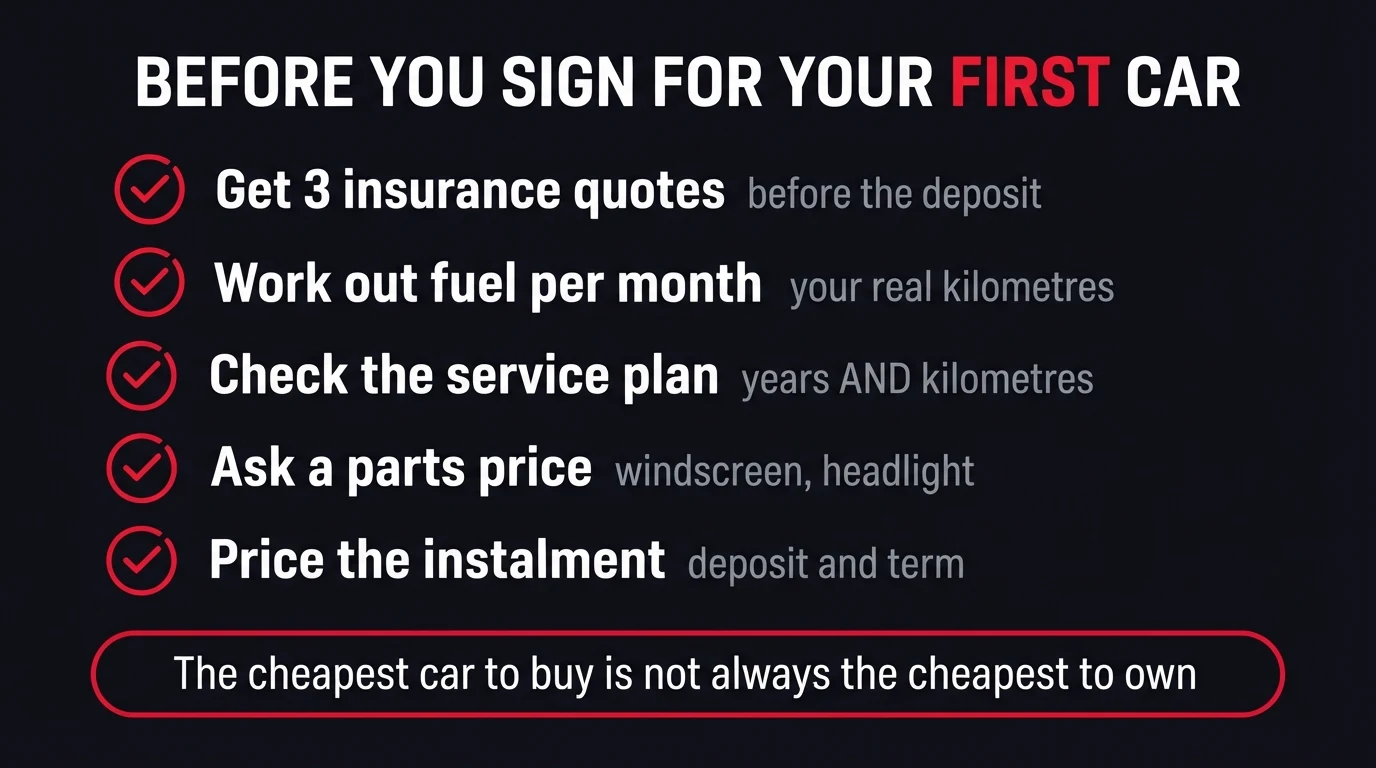
- Get three insurance quotes on each car you're seriously considering.
- Work out fuel on your real kilometres, not the brochure's. Multiply claimed consumption by your monthly distance, then add a margin.
- Check the service plan in years and kilometres. It ends at whichever comes first.
- Ask for two parts prices — a windscreen and a headlight. It tells you more about running costs than any review.
- Price the instalment with your real deposit and term, then add insurance and fuel to see the true monthly number.
Are parts and servicing easy to get for these cars?
Suzuki and Nissan have long-established dealer networks in South Africa, which is a real advantage on a first car: more workshops know them, and more parts are around.
Chery is newer to the local market and its network is still filling in. In practice, routine service items are rarely the problem; crash-repair panels and less common components can take longer. The LiT's 5-year service plan and warranty cover most of what goes wrong early.
Whichever you choose, find your nearest dealer workshop first. A great price on a car serviced 60 km away isn't a great price.
Should a first-time buyer go new or used at R250 000?
New, if a predictable monthly cost is the priority. A new car under R250 000 comes with a full warranty and service plan, which caps the bills you can't plan for.
Used makes sense if you want more car for the money — a bigger SUV or a higher spec — and can absorb a repair. Just know that at this price, the warranty and service plan are often partly or fully used up. Our used car buying guide for Johannesburg covers what to check.
Thin credit file? First-time buyers are often approved on a payslip, three months of bank statements and a deposit. Our guide on how much deposit you need to buy a car shows what each R10 000 down does — about R198 a month off the instalment at 12.5% over 72 months.
So which one should you buy?
It depends on how you'll use it. The straight version:
- Lowest total cost, mostly city driving: the Suzuki Swift 1.2 GL manual. We don't sell new Swifts — it's still the cheapest to run.
- Higher seating, longest warranty, Joburg potholes: the Nissan Magnite 1.0, from R239 900 at Tembani. Pick the EZ-Shift if you sit in traffic.
- Can stretch to R275 000 and want a proper small SUV: the Chery Tiggo Cross LiT manual at R273 500, with a 5-year service plan.
The short version
- Rank first cars on cost to own — insurance, fuel and services — not on sticker price.
- The Suzuki Swift 1.2 GL (R228 900) is cheapest to run on official fuel and service-plan figures.
- The Nissan Magnite 1.0 (from R239 900 at Tembani) gives SUV height and a 6-year / 150 000 km warranty.
- Insurance is the hidden decider for young drivers — get three quotes before you pay a deposit.
- Prices dated 1 November 2026; fuel at the October 2026 inland 95 price of R30.25 a litre.
Frequently asked questions
What is the cheapest new car to run in South Africa under R250 000?
On official figures, the Suzuki Swift 1.2 GL manual. Suzuki South Africa lists it at R228 900 with a claimed 4.4 litres per 100 km and a 4-year / 60 000 km service plan, so it is cheapest on fuel and on scheduled services. Claimed consumption is a lab figure, so expect real-world use to be somewhat higher for every car.
Is a Nissan Magnite a good first car?
Yes, if you want SUV-style ride height and a long warranty on a tight budget. The 1.0-litre Magnite makes 53 kW, claims 5.9 litres per 100 km and carries a 6-year / 150 000 km warranty. The trade-off is a 3-year / 30 000 km service plan, so a high-mileage driver pays for services sooner than on a Swift.
How much is insurance for a first car in South Africa?
There is no honest single figure, because the premium depends on your age, how long you have held a licence, where the car sleeps at night and the car itself. Get written quotes on your two or three shortlisted cars from at least three insurers before you pay a deposit. The quote, not the sticker price, often decides which car you can afford.
Should a first-time buyer buy new or used under R250 000?
New, if a predictable monthly cost matters more than the size of the car. At this budget a new car comes with a full warranty and service plan, which caps your surprise bills. R250 000 buys a bigger or better-equipped used car, but often with the warranty and service plan partly or fully used up, so budget for repairs.
What deposit do I need for a R250 000 car?
Banks can finance with no deposit if your credit profile is strong, but a 10% deposit is a sensible target. On a R239 900 car, 10% is R23 990, and at 12.5% over 72 months each R10 000 you put down cuts the instalment by about R198 a month. These are our estimates, not a bank quote.
Can I get car finance with no credit history?
It is possible, but harder, because the bank has little to judge you on. A payslip, three months of bank statements, a stable job and a deposit all help. We can send one application to several South African banks so you see who approves you and at what rate, instead of applying bank by bank.
Buying your first car and want the real monthly number?
Tell us which car you're looking at and roughly what you can put down. We'll work out the instalment, send your application to several banks, and show you the Magnite or Tiggo Cross LiT before you commit.