

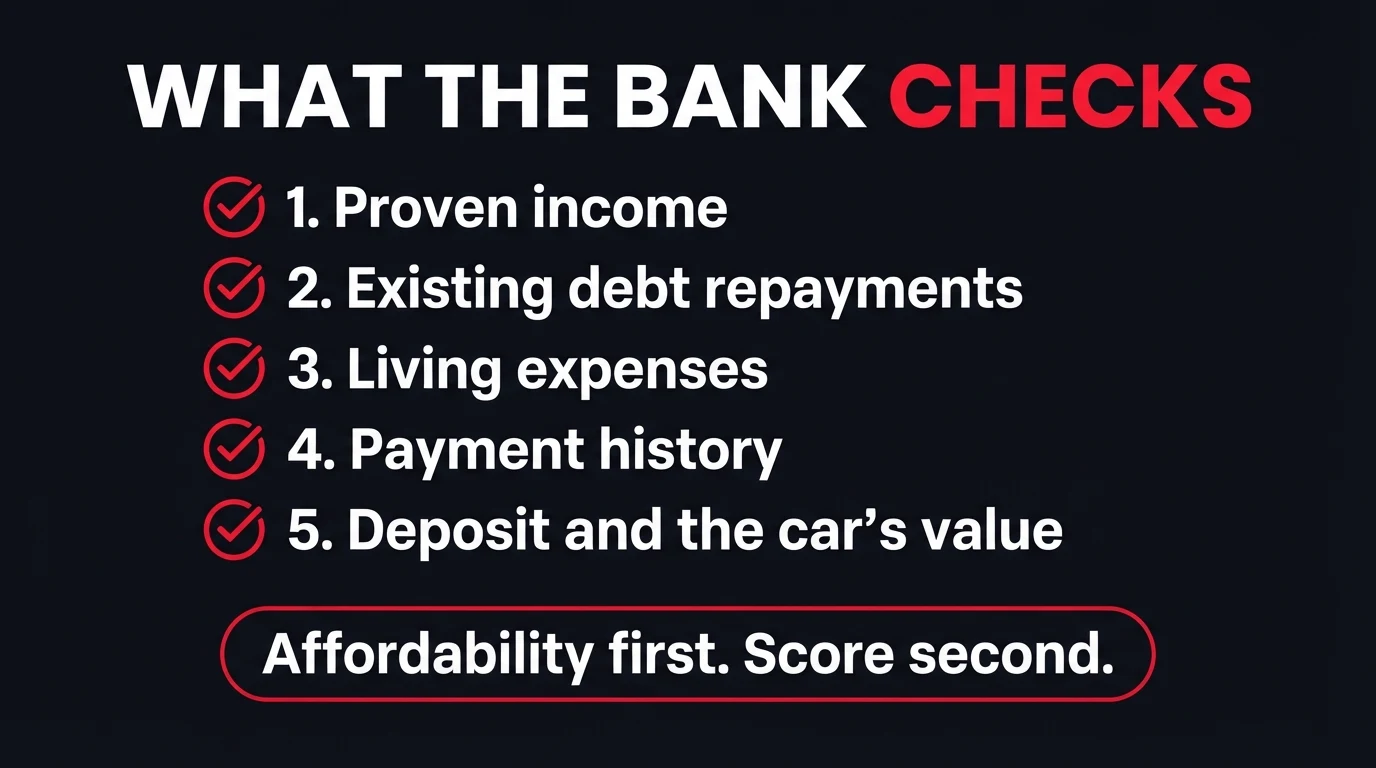
Banks look at affordability first: your verified income, minus your existing debt repayments and living expenses, must leave enough to cover the new instalment. Then they check your payment history on your credit report, your employment, and the deposit against the car's value. If you've been declined, affordability is the first thing to fix.
Last updated 20 October 2026
- The first thing a bank checks
- Whether the instalment fits your discretionary income — what's left after tax, existing debt and living expenses.
- Why it's not optional
- The National Credit Act requires every credit provider to do an affordability assessment before lending, or the loan can be treated as reckless credit.
- How your income is proven
- Salaried applicants: recent payslips or bank statements showing the salary deposit. Self-employed: bank statements or financial statements.
- What your credit report shows them
- Your credit applications, every credit agreement you have, your payment pattern, any defaults, and whether you are under debt review.
- When they pull it
- Your repayment history must be checked within seven business days before the finance is approved.
- The levers you control
- Paying down or closing small accounts, a bigger deposit or trade-in, a cheaper car, and clean, matching paperwork.
You found the car. The salesperson is friendly, the test drive went well, and then the finance comes back declined — with no real explanation. Most people assume their credit score is the problem. Often it isn't.
A bank in South Africa can't lend you money just because your record is clean. It has to prove, on paper, that you can afford the instalment. That one rule explains most of what happens to a car finance application.
What do banks actually look at when you apply for car finance?
Five things, roughly in this order: proven income, existing debt repayments, living expenses, payment history, and the deal itself — your deposit against the car's value and age. The first three together are the affordability test. The last two decide the rate and the terms.
| What the bank checks | Where they get it | What hurts you |
|---|---|---|
| Gross income | Payslips or bank statements; financial statements if self-employed | Income that can't be proven, or cash that never touches a bank account |
| Existing debt repayments | Every account on your credit bureau profile | Store cards, personal loans and clothing accounts eating into each month |
| Living expenses | Your declared expenses, tested against the regulated minimum expense norms | Declaring less than the minimum norms without being able to back it up |
| Payment history | Your credit report from a registered bureau | Recent missed payments, defaults, judgments or debt review |
| The deal itself | The car's price, age and value, and your deposit | Financing 100% of an older car with no deposit and a big balloon |
Why does affordability matter more than your credit score?
Because it's the law. The National Credit Act and its affordability regulations (Regulation 23A) require a bank to work out your discretionary income before it lends — and a loan granted without that check can be declared reckless credit.
The calculation is simple in shape. The bank validates your gross income, subtracts tax, subtracts every monthly repayment on your credit profile, subtracts maintenance and necessary expenses, and applies the regulated minimum expense norms — a sliding scale of living costs by income band. Whatever is left has to cover the new car instalment.
You can't simply declare R0 for groceries to squeeze an approval through. If you declare expenses below the minimum norms, the regulations only allow the bank to accept that on an exceptional basis, with a prescribed questionnaire completed.
This is why a person with a spotless record can still be declined. A clean score doesn't create room in a budget that isn't there.
How much does your credit record count?
A lot — but mostly for the rate and the terms, once affordability is passed. The bank must check your repayment history within seven business days before approving the finance, so what's on your report that week is what they see. The rate also moves with the repo rate — here is what a repo rate hike does to your instalment.
According to the National Credit Regulator, your credit report shows your credit applications, every credit agreement you have or had, your payment pattern, any defaults, and whether you are under debt review. Banks read the pattern, not one number: a missed payment last month weighs more than one from four years ago.
If your record has a judgment or a debt review flag, that's a separate conversation — we cover it in can you get car finance if you're blacklisted.
Why do different banks give the same person different answers?
Every bank runs its own scoring model and its own risk appetite. They all do the same legal affordability test, but one bank may be comfortable with your job sector, a seven-year-old car, or a thinner credit history, while another isn't.
That's the practical reason to have an application submitted to more than one bank. Applying only at the bank where you have your cheque account feels safe, but it gives you exactly one opinion on a decision where opinions differ.
What should you fix in the three months before applying?
Picture this: you know you'll want a car in March. What you do in December, January and February shows up directly on the payslips, bank statements and credit report the bank will read. Three months is enough to move the needle.
- Pull your free credit report. You're entitled to one free report a year from each consumer bureau — Experian, TransUnion, XDS and Consumer Profile Bureau. Read it before a bank does.
- Dispute anything wrong. Go to the bureau that issued the report first, with proof; escalate to the Credit Ombud only if the bureau can't resolve it.
- Kill the small accounts. Settle and close store or clothing accounts you don't need. Each one is a monthly repayment the bank subtracts from your income.
- Pay every account on time, every month. Three clean months is the most recent history the bank will look at.
- Keep your bank statements boring. Salary in, debit orders out, no bounced debits, no unexplained cash deposits.
- Build the deposit. Cash saved, or the value of your current car as a trade-in, lowers the amount the bank has to lend.
No dealer or "finance consultant" controls a bank's decision. Anyone who asks for an upfront payment to guarantee your approval, or offers to "fix" your payslips, is either scamming you or setting you up for fraud.
What documents do you need for car finance?
Have these ready before you choose the car — a complete, matching application is processed faster and reads as lower risk. Requirements vary slightly between banks, so confirm the list with us or your bank as of the date you apply.
| Document | Salaried | Self-employed | Why the bank wants it |
|---|---|---|---|
| SA ID | Yes | Yes | Identity and FICA |
| Valid driver's licence | Yes | Yes | You'll be the one driving the financed car |
| Latest payslips | Usually 3 months | — | Validates gross income |
| Bank statements | Usually 3 months, salary visible | Usually 6 months of business statements | Confirms income actually lands and shows your debit orders |
| Financial statements or tax return | — | Latest available | Income proof where there is no payslip |
| Proof of residence | Not older than 3 months | Not older than 3 months | FICA address verification |
If your pay includes commission or overtime, the regulations require the bank to average your income over at least three pay periods — so a single big month won't carry the application on its own.
Does a bigger deposit or a trade-in actually help?
Yes, on two fronts. A deposit lowers the instalment, which helps the affordability test directly, and it lowers what the bank stands to lose, which helps the rate. Our guide on how much deposit you need to buy a car goes through the numbers.
It doesn't have to be cash. A trade-in valuation on the car you already drive can supply the deposit. Be careful of the other shortcut, though: a large balloon payment makes the instalment look affordable today and leaves a lump sum for later — read how balloon payments work before you lean on one.
And sometimes the strongest move is a cheaper car. A Chery Tiggo Cross LiT at the lower end of the new-car market passes an affordability test that a bigger SUV on the same salary won't.
The short version
- Affordability is the gate: income minus debt and living expenses must cover the instalment, by law.
- Your credit record sets the terms: recent payment history matters more than old mistakes.
- Banks disagree: each has its own scoring, so apply through more than one.
- Three months of preparation — closing small accounts, paying on time, clean statements — changes what they see.
- A deposit or trade-in helps both the affordability test and the rate.
Frequently asked questions
Do banks look at my credit score or my affordability first?
Both, but affordability is the hard gate. Under the National Credit Act a bank must show the instalment fits your discretionary income before it can lend, so a good score with no room in your budget still gets declined. A weaker score with real breathing room in your budget often gets an offer, just at a higher rate or with a bigger deposit.
How many payslips do I need for car finance in South Africa?
Banks typically ask for your latest three payslips and three months of bank statements showing the salary going in. If your income varies month to month, because of commission or overtime, the affordability regulations require the bank to use an average over at least three pay periods, so three months is the practical minimum to have ready.
Can I get car finance if I am self-employed?
Yes, but expect more paperwork. The affordability regulations let a self-employed or informally employed applicant prove income with bank statements or financial statements instead of payslips. Banks generally want to see a steady business income over a longer period, so have at least six months of business bank statements and your latest financial statements or tax return ready.
Why did one bank approve me and another decline me?
Because every bank runs its own scoring model and has its own appetite for risk. All of them must do the same legal affordability check, but how they weigh your score, your job, the car's age and your deposit differs. That is why an application sent to several banks at once usually gets a better result than applying to your own bank alone.
How do I get my free credit report?
Request it directly from one of South Africa's consumer credit bureaus: Experian, TransUnion, XDS or Consumer Profile Bureau. The National Credit Act entitles you to one free credit report a year from each bureau. Do not pay a third party to get it for you, and check it before you apply, not after a decline.
What if something on my credit report is wrong?
Dispute it with the credit bureau that issued the report, in writing, with whatever proof you have, such as a paid-up letter or a settlement statement. The National Credit Regulator advises going to the bureau first and escalating to the Credit Ombud only if the bureau cannot resolve it. Fix it before applying, because the bank will read the record as it stands.
Will Tembani Sales guarantee my car finance will be approved?
No, and be careful of anyone who does. We submit your application to the major South African banks on your behalf, but the approval, the rate and the terms are entirely the bank's decision. What we can do is look at your numbers honestly before you apply and tell you where the weak spot is likely to be.
Want a straight read on your numbers first?
Send us your situation before you apply. We'll tell you honestly where a bank is likely to push back, and submit your application to several banks at once when you're ready.