

If your car loan is linked to prime, your instalment goes up. The South African Reserve Bank raised the repo rate by 0.25 percentage points to 7.25% from 25 September 2026, taking prime to 10.75%. On R350 000 financed over 72 months, that adds about R46 a month. Fixed-rate loans don't move.
Last updated 26 October 2026
- Repo rate
- 7.25%, up from 7%, effective 25 September 2026.
- Prime lending rate
- 10.75%, up from 10.5% — prime sits 3.5 percentage points above repo.
- Who decided, and how
- The Reserve Bank's Monetary Policy Committee, unanimously, announced on 23 September 2026.
- What 0.25% costs on a car loan
- Roughly R13 a month for every R100 000 financed over 72 months.
- Hikes so far in 2026
- Two: one at the May meeting (to 7%) and this one (to 7.25%). July was a hold.
- Next decision
- The Monetary Policy Committee is due to announce on 19 November 2026.
A finance offer you were happy with in August now costs a little more. Not dramatically more — but a little more every month for six years adds up, and it's worth knowing the real number before you sign.
What did the Reserve Bank actually decide in September 2026?
It raised the repo rate by 25 basis points to 7.25%, effective 25 September 2026, and the decision was unanimous. That's the second hike this year, after the rise to 7% at the May meeting.
In the official September 2026 MPC statement, Governor Lesetja Kganyago pointed to higher fuel prices as the main reason the Bank raised its near-term inflation forecasts. Headline inflation was 4.4%, and the Bank expects it to go above 5% later this year and early next year, peaking around 5.7% in November 2026.
The July meeting had held the rate at 7% on a split four-to-two vote, according to the July 2026 MPC statement. September's fuel shock ended that pause.
Repo vs prime, in one line: the repo rate is what the Reserve Bank charges the banks; prime is what the banks charge their best customers, set 3.5 percentage points higher. Your car finance rate is quoted against prime.
How much more will my car instalment be?
For a typical car loan, about R13 a month per R100 000 financed for this single 0.25 point move, and about R26 per R100 000 for the full 0.5 point rise since before the May hike. These are our own calculations, not a bank quote.
| Amount financed | At 12.00% | At 12.25% | At 12.50% | Extra since May |
|---|---|---|---|---|
| R250 000 | R4 888 | R4 920 | R4 953 | +R65 pm |
| R350 000 | R6 843 | R6 888 | R6 934 | +R91 pm |
| R450 000 | R8 798 | R8 856 | R8 915 | +R117 pm |
Illustrative only: 72 months, no deposit, no balloon, rate fixed for the whole term, excluding bank fees and insurance. The three columns show a rate 0.5 points lower, 0.25 points lower, and at the 12.5% example rate used elsewhere on this site. Your actual rate depends on the bank and your credit profile.
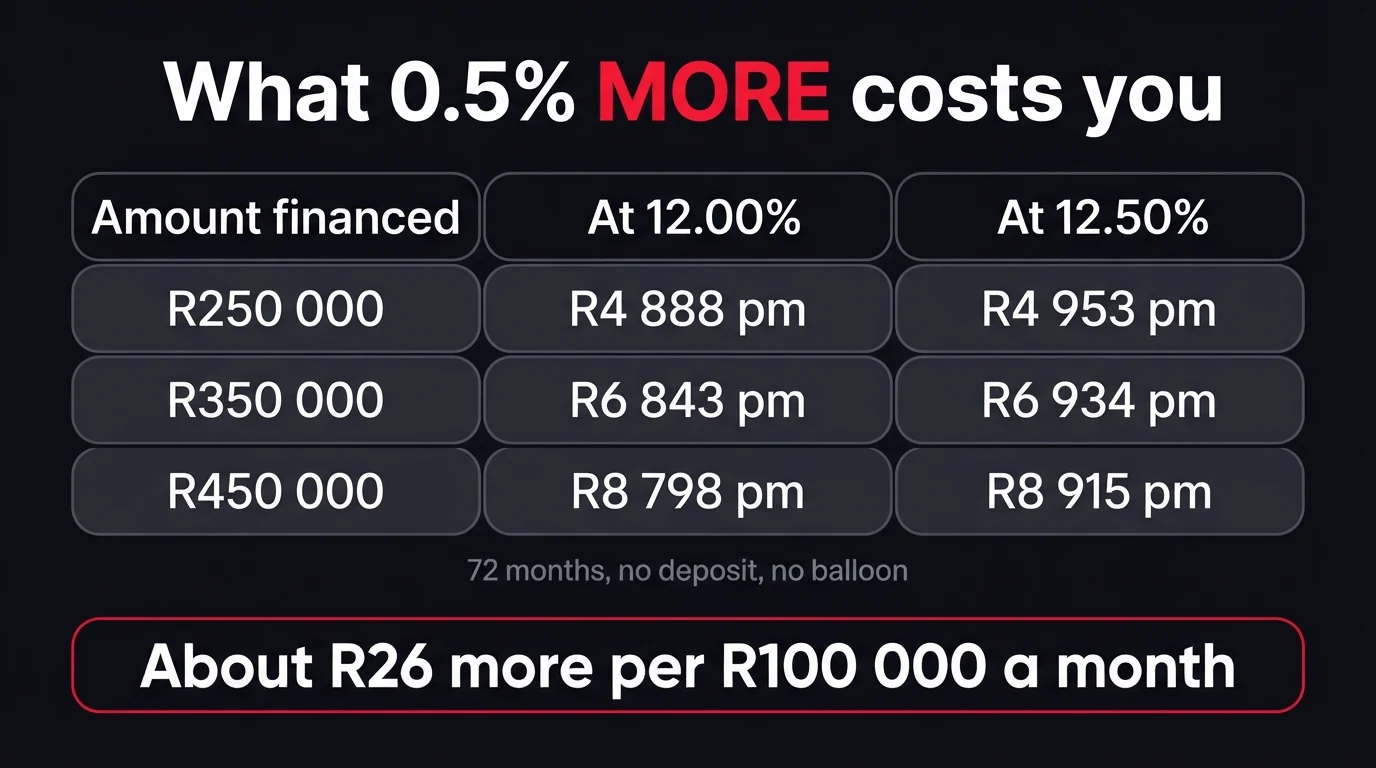
Over the full six years, that 0.5 point rise on R350 000 comes to roughly R6 600 extra. Real money — but smaller than a R10 000 difference in the price of the car itself.
Does the hike change my existing car loan, or only new ones?
Both, if your rate is linked to prime. A linked rate is written as "prime plus" or "prime minus" a margin, so when prime moved on 25 September your rate moved with it and your instalment was recalculated.
If you signed a fixed-rate agreement, nothing changes for the period the rate is fixed. Not sure which you have? Check your finance agreement, or the rate shown on the vehicle finance account in your bank's app or statement.
With a balloon, you pay interest on that lump sum for the whole term. On R350 000 over 72 months with a 30% balloon (R105 000), the same 0.5 point rise adds about R107 a month — more than the R91 on the same loan without one. Read how balloon payments work before you lean on one to make the numbers fit.
Should you wait for rates to come down before buying?
Picture this: you've found the car, the bank has approved you, and someone tells you to hold off "until rates drop". Waiting is a bet, not a plan — and the Reserve Bank itself isn't promising a cut soon.
In September the Bank said its forecasting model has the rate broadly stable for the rest of 2026, with cuts only later as inflation falls back to 3%, which it expects towards the end of 2027. It also stressed that it decides meeting by meeting.
Meanwhile, a 0.25 point cut would save about R13 a month per R100 000. The car's price, your deposit and the rate the bank offers you personally all move the instalment far more than that.
What can you do to soften a higher instalment?
Pull the levers you control. The repo rate isn't one of them; the amount you borrow and the rate you're offered are.
- Put down a deposit or trade in. Every R10 000 less financed cuts about R198 a month at 12.5% over 72 months. A trade-in valuation on your current car can supply it.
- Get more than one bank to quote. Each bank prices your risk differently, and a lower margin on prime is worth more than any single repo move.
- Clean up your credit profile first. A better record earns a better margin. Our guide on what banks actually look at when approving car finance covers what to fix.
- Ask for a linked and a fixed quote side by side. A fixed rate protects you from further hikes but won't follow cuts — compare the starting rates before you choose.
- Look one step down the range. A Chery Tiggo Cross LiT at the lower end of the new-car market keeps the amount financed down.
Our guide on how much deposit you need to buy a car runs the deposit numbers in more detail.
The short version
- Repo is 7.25% and prime is 10.75% from 25 September 2026, after a unanimous 0.25 point hike.
- Linked car loans went up automatically; fixed-rate loans did not.
- The cost is about R13 a month per R100 000 financed over 72 months for this hike.
- A balloon makes rate rises bite harder, because you pay interest on the lump sum.
- The next decision is 19 November 2026 — and the Bank expects rates broadly stable for the rest of the year.
Frequently asked questions
What is the prime rate in South Africa now?
As of 26 October 2026, prime is 10.75%. It moved up from 10.5% on 25 September 2026, when the South African Reserve Bank's repo rate rise to 7.25% took effect. South African banks set prime 3.5 percentage points above the repo rate, so the two always move together.
Will my car repayment go up automatically?
Only if your rate is linked to prime rather than fixed. A linked rate is quoted as prime plus or minus a margin, so when prime rises your rate rises with it and your instalment is recalculated. Check your finance agreement or your bank's app to see whether your rate is linked or fixed.
Does a repo rate hike affect a fixed-rate car loan?
No. If you signed a fixed-rate agreement, your rate and instalment stay the same for the term the rate is fixed for, whatever the Reserve Bank does. The trade-off is that a fixed rate also does not come down when the repo rate is cut, so compare the starting rates carefully when a bank offers you both.
When is the next repo rate decision?
The Reserve Bank's Monetary Policy Committee is due to announce its next decision on 19 November 2026. In its September statement the Bank said its model shows the rate broadly stable for the rest of 2026, but it decides meeting by meeting, so treat that as a guide rather than a promise.
Is now a bad time to buy a car in South Africa?
Not because of this hike on its own. A 0.25 percentage point rise adds roughly R13 a month per R100 000 financed over six years. The car's price, your deposit and the rate the bank offers you personally move the instalment far more. If you need a car now and the numbers pass, waiting for a cut is a gamble, not a plan.
Does Tembani Sales set my interest rate?
No. We submit your finance application to the major South African banks, and each bank decides whether to approve you and at what rate, based on your credit profile and the deal. What we can do is send it to more than one bank so you can compare the offers side by side before you sign.
Want to see what your instalment looks like at today's prime?
Tell us the car and roughly what you can put down. We'll send your application to several banks so you can compare real offers at the new rate — not a guess.